
Author: Maddie

  • Biggest Changes to Google Ads in the Past Five Years

    Biggest Changes to Google Ads in the Past Five Years

    Google ads is always changing and evolving. With the rapid advancement of technology and AI over the past 5 years these changes seem to be bigger and more rapid. So, if you have been out of the game for a little while and are looking to jump back in, the landscape might look entirely different. Have no fear! We are here to catch you up on some of google ads’ biggest changes in the past few years and teach you how to best navigate them.

    Though google ads has changed in more ways than what is discussed below, we wanted to highlight the biggest changes that nearly every advertiser is likely to encounter. Buckle in because we are going to go over changes to ad types, keywords, campaign types and so much more. 

    Search campaigns show ads to those actively searching on google and we would argue that almost every Google ads advertiser has run a search campaign at some point in their career.

    Originally these campaigns would be made up of expanded text ads. When creating an expanded text ad, advertisers would only enter three headlines and two descriptions, knowing this was the exact ad that would be delivered. 

    In 2018, Google introduced Responsive search ads. With responsive search ads, advertisers are able to enter 15 headlines, 4 descriptions and up to 20 images. Google will then dynamically create an ad based on your inputs and the search.  

    Some advertisers were leary at first because they felt that with this new ad type they had less control over what was being shown. Now 7 years later advertisers have warmed up to Responsive search ads because Google, in theory, will show the best combination based on prior asset performance and the user’s search. We have also seen google weed out (stop showing) lower performing copy and then recommend advertisers ad new copy. 

    On Feb 21st, 2021 Google announced responsive search ads are now the primary ad type for search campaigns and expanded text ads would no longer be available. 

    If advertisers have active expanded text campaigns in their campaigns, these ads still show however they can not be changed and new expanded ads could not be added. 

    The second biggest change to Google ads is the evolution of keyword match types. Google’s keyword match types used to include, broad match, broad match modifiers, phrase match and exact match. 5 years ago google’s definition of these match types was pretty self explanatory, however now broad match modifiers don’t exist and google has introduced “close variants”. 

    Advertisers used to be able to select one match types and have a pretty clear understanding of what search terms their ads would appear for. Now, with the introduction of close variants, a lot of lines are blurred. Exact matches are no longer exact, and phrase match, we would argue, looks an awful lot like broad match. 

    For example, one of our clients used the phrase match keyword “lunch near me” and was shown for the search term “chicken caesar salad wrap near me”. The issue: they don’t have a chicken caesar salad wrap on their menu. Therefore this wasn’t a high value user. 

    Google is also pushing advertisers to use broad match keywords. To use, this seems like Google is adopting a “google knows best” mindset and taking the control away from advertisers. Knowing the definitions are getting broader, we recommend advertisers keep a close eye on their keywords and search terms while building out negative keyword lists. Go ahead and experiment with broad match. It might work for you, but don’t be afraid to rain it back into phrase and exact match if you aren’t seeing your desired results. 

    Google Ads’ Lookalike Audiences, also known as Similar Audiences, were a powerful targeting tool that helps advertisers reach new potential customers who resemble their existing audience. Advertisers would upload a list of first party data and google would create an audience that shared similar characteristics based on this list. 

    As of 2023 this helpful tool no longer exists. Lookalike audiences can no longer be created. Google said it made this change because with the changing restrictions of online marketing it wants to stay ahead of the shift by leveraging their AI abilities. Instead of lookalike audiences Google is encouraging advertisers to use optimized targeting, audience expansion, and Smart Bidding instead. We won’t argue these AI tools are powerful, but make no mistake none of these are a direct comparison to similar audiences and will not provide you with that data. 

    Speaking of Google’s AI abilities, they are really put to the test with Performance Max Campaigns.

    Performance Max Campaigns are powered by AI and utilize all of Google’s channels including, search, display, youtube, gmail, maps, and discovery. Advertisers add input like headlines, descriptions, videos and images to an asset group and then Google generates ads based on the conversion goal set. 

    We have noticed some great results when using these campaigns. It is clear that Google is optimizing based on the goals set, but there are two things to keep in mind before jumping into using Performance Max campaigns. 

    One: Advertisers have less control. Advertisers are not entering in search keywords rather they are entering suggestions. Advertisers aren’t delegating budget to each channel, rather google is delegating the budget to what it thinks will reach the set goal. Advertisers have to trust that Google knows how to optimize properly.

    Two: Advertisers won’t get detailed reports. Google provides general insights and will give the basic conversion, impression, click data for the campaign as a whole, but advertisers won’t know what in that campaign is working. For example, Google might report that there were 10 conversions this week but advertisers won’t know if those came from search, display or one of the other channels.

    Like we said, Performance Max campaigns can be very useful, especially for those who don’t have a lot of time to manage google campaigns, but advertisers have to be comfortable with less control and less visibility in reporting.  

    In response to the rising concerns over data privacy Google introduced Enhanced conversions in 2021. Instead of using cookies and basic pixel tracking, enhanced conversions utilizes first-party customer data to provide more accurate attribution. 

    Enhanced conversions securely hash and match customer data such as emails, phone numbers, or addresses against Google accounts. This advanced technique allows for better accuracy in tracking conversions. As a result, businesses gain deeper insights into their customer’s journey, enabling more precise optimization of ad campaigns and ultimately driving improved ROI. Enhanced Conversions ensure that advertisers can adapt to the evolving digital ecosystem with more reliable and comprehensive tracking capabilities.

    Enhanced conversions tracking is one change that we recommend you learn and implement so you have the most accurate data for your business. 

    The final and most obvious biggest change to Google Ads that you will notice the second you log in is the new platform layout. In early 2023 Google announced it was testing new Google Ads designs. After testing 2 layouts they landed on a winner that “reorganized pages into more thematically linked groups”. Google also wants to make it clear that with this new layout, advertisers are able to do everything they could do with the old layout, it just might be in a different spot than they are used to. 

    With this test came feedback that google is taking into account as it perfects the new design. Some of the primary concerns were that the new location of search terms makes for an awkward workflow and that the new menu takes up too much space. Google has acknowledged these concerns and is working on solutions. 

    At the time of this article advertisers are still able to switch back and forth between layouts as they get used to the new feel but they are expecting to do away with the old layout later this year. 

    Google Ads has undergone significant transformations over the past five years, redefining how advertisers approach digital marketing. From the transition to Responsive Search Ads and the broadening of keyword match types to the retirement of Lookalike Audiences and the introduction of AI-driven Performance Max Campaigns, the platform is continuously evolving. We hope that we were able to highlight some of the biggest changes to Google ads over the past five years and help you navigate them a bit better. 
  • 5 Common Mistakes in Google Ads

    5 Common Mistakes in Google Ads

    Maximize the Effectiveness of You Ad Spend

    Maximizing the effectiveness of your Google Ads campaigns starts with avoiding common pitfalls. From improper conversion tracking to overlooking vital ad assets, each step can significantly impact your campaign’s success. In this comprehensive guide, we’ll explore five critical mistakes to steer clear of and provide actionable tips to ensure your ads drive results. Let’s dive in and optimize your advertising strategy for maximum impact and ROI.

    1. Improper Conversion Tracking

    One of the most important things when first setting up Google ads is to make sure you have proper conversion tracking set up. Without conversions tracking a couple of things will happen. First, Google won’t know what to optimize. Secondly, the absence of accurate data hinders your ability to assess the effectiveness of your strategies.

    So, let’s jump into a few things to check when setting up conversion tracking:

    1. Primary Vs. secondary conversions. Google will automatically track and optimize to your primary conversion and only track your secondary conversions. So, if submitting a lead or a sale are the most important conversion actions for you, then make sure these are set as primary and not secondary conversions. 
    2. Don’t over clutter your conversion actions. We like to say “if everything is important then nothing is important”. We recommend choosing the most important conversion actions and tracking those. This might seem simple, however, sometimes Google will recommend many conversion events, including individual page views and link clicks which most likely are less valuable to you than a purchase, call or lead form submission.
    3. Tracking conversion value. Once a user has landed on your website and made a purchase or closed a deal, it’s important to send that purchase value back into google. This way you can track your return on investment instead of just the number of conversions.  

    2. Not Setting an Ad Schedule 

    Google allows you to set an ad schedule based on the day or the hour. You could hypothetically run ads at a different time every day, though we can think of many reasons you’d need to do that. 

    Creating an ad schedule that suits your company is key. This can be done right off the bat or once you have more data. 

    For instance if you are a B2B organization, running ads Mon-Fri is most likely the way to go. Why waste your money on the weekends when people aren’t at work. In the same vine you might run ads from 9am-5pm to coincide with the average work schedule. 

    When you are setting up your campaigns you might have no idea when your consumers are most active. No worries! You can always run your campaigns 24/7, and after a couple of weeks and enough data, you can assess when conversions are coming in, and cost/conversion then adjust accordingly. 

    Running ads on a schedule doesn’t have to be an all or nothing either! You might notice that for some reason on Wednesdays, your conversions and ROI are down but you still want ads to appear on Wednesdays. If you are setting manual bids you can adjust the maximum bid based on the time and day. So on Wednesdays you can set your max bid to 50% of what your normal max bid is to lower spend. 

    3. Blindly Accepting All of Google’s Recommendations

    Don’t get us wrong, Google can have great recommendations but sometimes they can be overzealous and it can lead you down a path you definitely don’t want to go down. For instance, Google will often make recommendations that include a budget increase, which you might not have. It’s okay to tell Google no even if your optimization score goes down a bit. 

    Another recommendation you should keep an eye on is the key word changes. Google will frequently recommend broad match keywords and we have noticed sometimes they aren’t afraid to add +150 broad match keywords to one ad group. For some, this may be okay, but for others this can lead to irrelevant search terms and messy keyword data. 

    Not all of Google’s Recommendations are bad, some can be very helpful but make sure to not blindly accept all of their suggestions without thinking about how it will affect your business. 

    4. Not setting up location targeting

    Don’t forget to set up Location targeting for your ads based on your company’s needs. Google allows advertisers to select what countries, states, or zip codes their ads appear in. Google also allows you to set areas that you don’t want to advertise in. 

    No one likes wasted ad spend and the quickest way to lose money is to advertise in areas where your business is less or not relevant. For instance, if you run a brick and mortar store you should set up location targeting based on the area around your store. No need to be advertising in Texas if your store front is in Chicago, IL. 

    Location targeting is relevant if you have an online store too. Let’s say your company sells snow blowers. Well, once again advertising in Texas might not be the biggest bang for your buck.

    Sure over 5 years I’m sure someone will buy a snowblower in Texas for some reason or another but you’d be better off concentrating your ad spend on places like Wisconsin, Michigan or New Hampshire. 

    5. Lack of Ad Assets

    Our final mistake we see advertisers make is not utilizing assets! Advertisers should use assets in Google Ads because they play a crucial role in creating compelling and effective advertisements that increase ad relevance and increase ad quality score. 

    When creating an ad it’s hard to miss the basics like headlines and descriptions because they are required, but don’t forget about the optional ones. You used to have to add the optional assets to an ad after the ad was created in the asset tab.

    Now Google has made it easier and gives advertisers the option of adding assets and extensions to the ad while making the ad itself. Some of these assets are:

    • Sitelink extensions
    • Call outs
    • Structured snippets
    • Photos
    • Location extension
    • Lead form extension
    • Call extension
    • Price extensions
    • Image extensions

    These different assets allow you to link to relevant  pages on your site, highlight important details about your company, and provide contact information up front. Overall assets can be used to provide more information and make your ad more attractive to potential customers. 

    That being said, not all assets are relevant to every business. For example, you might not take calls or you might sell products solely online and not have a location. That’s okay! Use all that pertains to your business to maximize ad quality score. 

    Wrapping Up 

    In conclusion, mastering Google Ads requires diligence and strategic planning to avoid common pitfalls that can hinder your campaign’s performance.

    By ensuring proper conversion tracking, setting up ad schedules tailored to your target audience’s behavior, critically evaluating Google’s recommendations, implementing precise location targeting, and leveraging ad assets effectively, you can maximize the effectiveness of your advertising strategy.

    With these insights and actionable tips, you’re equipped to optimize your campaigns for maximum impact and ROI. Here’s to your success in the dynamic world of digital advertising!

  • A Guide To Google Ads With Wix

    A Guide To Google Ads With Wix

    Using Wix to Set-up Google Ads

    Starting a business is no easy feat and includes a lot of steps. Two of which are making a website and getting said website in front of customers to promote your product or services.

    If you have ever thought about setting up a website before, we are sure most of you have heard of a little platform called Wix, an easy to use, code free website developer. However did you know that Wix also allows you to set up Google ads directly from their platform? 

    We know that when starting a business there is also a LOT of research that needs to be done. Scouring the internet, bouncing from page to page, trying to decide which path is best, and not everyone has time for that.

    Today we are going to keep it all in one place! Everything you need to know about using Google Ads through Wix and if it’s better than setting up a Google Ads account directly through Google. 

    How To Set Up Google Ads on Wix

    Before we go through the pros and cons of using Wix to set up Google Ads, let’s walk through the steps to set it up. Wix keeps things pretty simple so there are only 5 main steps we are going to touch on.

    1) Set up location targeting

    Advertisers are able to enter up to ten locations based on country, state, city, zip code, and region, or advertisers can enter a street address that they want to advertise near.

    2) Set Up Ad Schedule

    Choose if you want to run your ads all the time or at specific times. If you opt for specific times you can then choose which days and which hours your ads run.  

    3) Select Keyword Themes

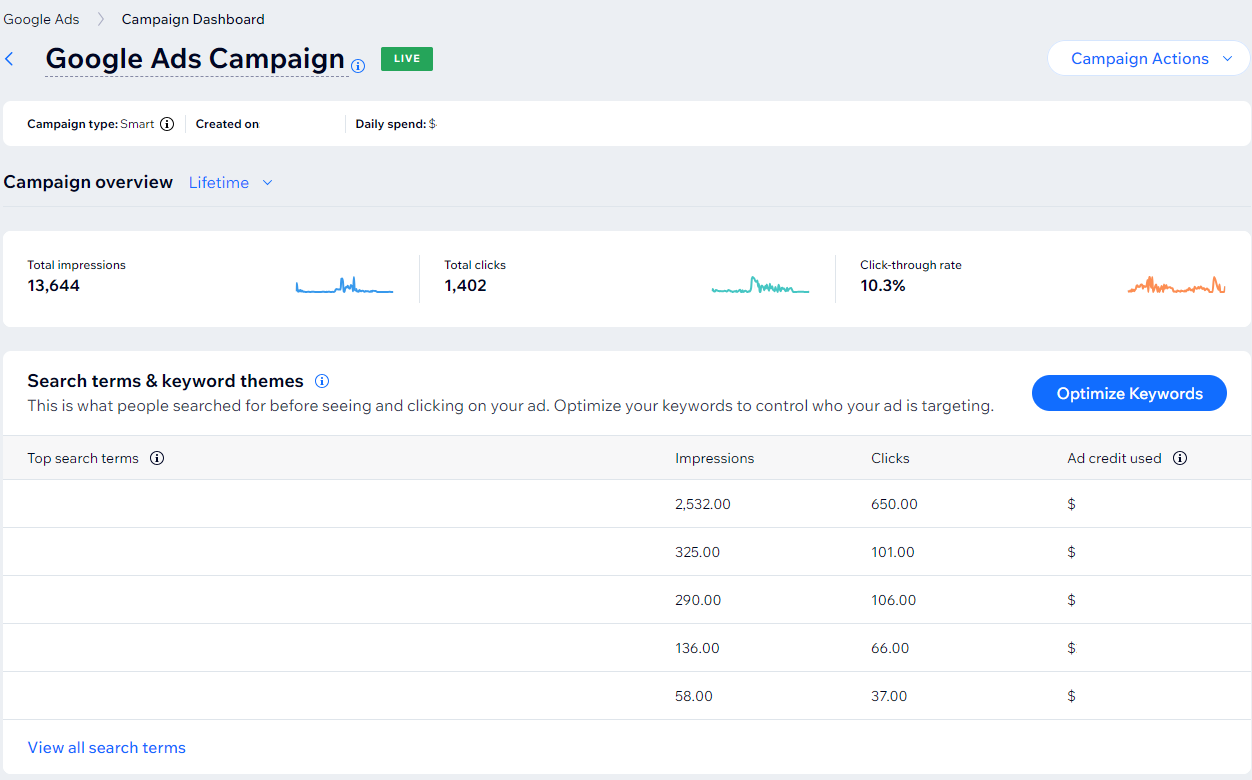
    You can then select up to 10 keyword themes that you think are relevant to how people might be searching for products and services like yours. You can enter in your own keywords or pull from Wix’s suggestions. You only get 10, so choose your themes carefully to encompass everything that you want your campaign to target. 

    4) Assets

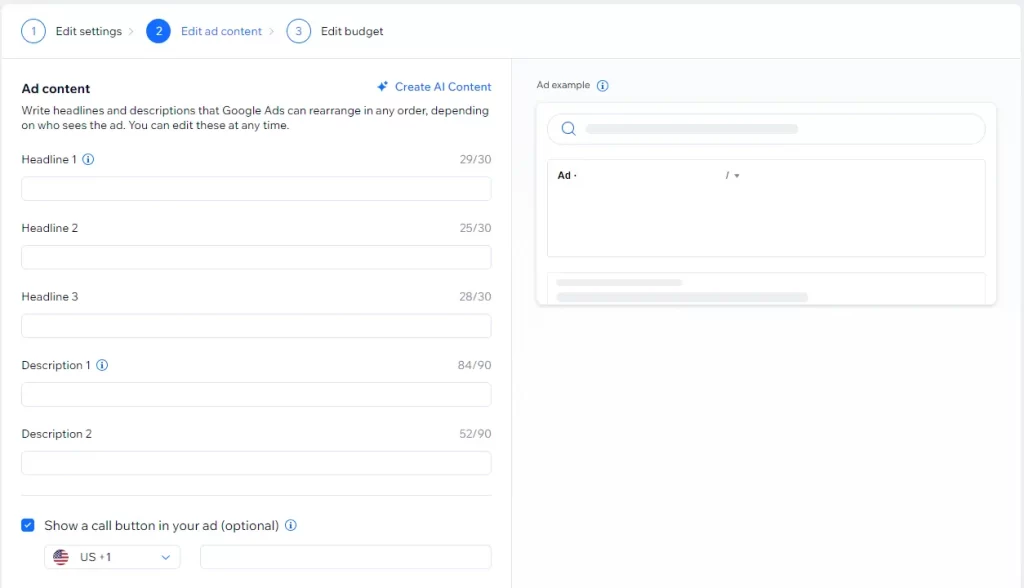
    Advertisers enter in 3 headlines and 2 descriptions about their company and landing page. This is what will appear when your ad shows to users.

    5) Set Budget

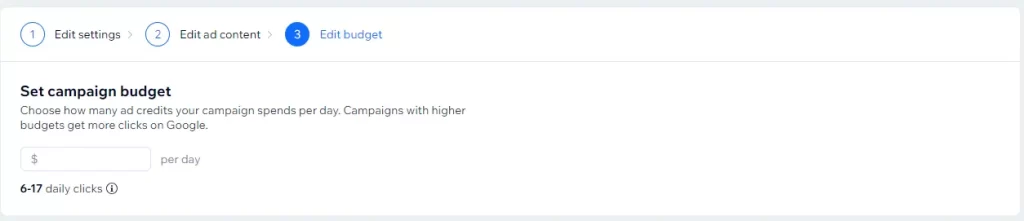
    For Wix, you must first purchase a monthly subscription starting as low as $150 a month. This will then pool as the ad credit acting as the money that your campaigns can then pull from when you set your daily spend on the campaign level. It’s important to keep in mind that your campaigns also have a minimum daily spend so if you have a second campaign you will need to purchase more ad credit via a one time purchase or an increase in the monthly subscription. 

    Pros of Running Google Ads Through Wix:

    And just like that, in five easy steps, you have yourself a Google Ads campaign set up through Wix, which leads us to our first pro for using the Wix platform to run Google Ads.

    Pro 1) It’s Easy

    Wix uses a simplified version of Google Ads that allows you to run search ads, as opposed to the Google Ads platform which has a number of different ad types, complex targeting, and more nuanced ad set up.

    Though some people like the bells and whistles of Google Ads, not every company has the band-with to set up and manage complex campaigns.

    Wix’s easy to use pared down platform is efficient. Plus it comes with step by step tutorials to walk you through how to set up Google Ads in Wix.  

    Pro 2) Integration

    Using the same platform cuts down a lot of time. Right off the jump, you don’t need to create a Google Ads account, become a verified advertiser, or enter credit card information into a new platform.

    In fact, You don’t need to learn another platform at all, because it’s all right in Wix, so you are already familiar with their tools.

    Pro 3) Singular Platform (part one)

    The pro of a singular platform in terms of integration is great but there is a lot to be said for its simplicity of a singular platform in the long term.

    Let’s be honest, as a business owner there is a lot to manage and that includes the 101 tabs open on your computer that you need to check on.

    Well advertising through the Wix platform instead of the Google Ads platform cuts down on one extra tab that you have to remember to check.

    Instead of bouncing around between Wix and Google Ads you are able to view your advertising data alongside your organic data on one platform.

    Time is money and there is a lot of time being saved by having one less platform to pay attention to.

    Cons of running Google Ads Through Wix

    There are a lot of pros to using the Wix platform to run Google Ads but some of those very things that are pros can quickly become cons for advertisers.

    Con 1) Limited Data

    Having one platform is great when you don’t have time to learn or set up a Google Ads account, however it also means that Wix is not built to report the same way the Google Ads platform reports.

    Wix has very limited data compared to Google Ads.

    In Google Ads, advertisers have the ability to do detailed audience reports, gather data on individual keywords, and track many metrics such as impression share that Wix does not report.

    This lack of reporting prevents advertisers from gathering insights on their target market and limits ad optimization. 

    Con 2) Limited Ad Control

    Again another pro that can quickly become a con. Wix has a simplified ad set up, which makes ads easy to build, but easy doesn’t necessarily mean better. Here are a few ways Wix is limiting:

    The biggest drawbacks of ads on Wix is that you can only run search ads, so any display or video advertising is out of the question from the jump. 

    Wix also doesn’t allow for more than 3 headlines and 2 descriptions. In Google, Advertisers are able to enter up to 10 headlines and 4 descriptions that then get optimized based on performance.

    On Wix, advertisers can’t add extensions to their ads, meaning they are missing out on images, pricing, and call outs that can help an ad stand out, be competitive and attract users.

    Finally, Wix has advertisers pick out keyword themes and not specific keywords, meaning that the search terms your ads are showing up for are more broad and might not be relevant. Thus, there is also less data on the success of a keyword/keyword theme.

    Con 3) Campaign = Ad

    Right now every ad that is created in Wix is its own campaign. In Google Ads there are campaigns, ad groups and then ads.

    There can be more than one ad group in a campaign and more than one ad in an ad group, allowing advertisers to organize ad content and gather data on different markets in a concise manner. 

    Con 4) Google Ads and Wix Don’t Connect

    Though you are able to advertise with Google Ads through Wix they are separate platforms.

    This means, if you start advertising through Wix and then decide you want to switch to using the Google Ads platform for all the tools and data that Google provides, you aren’t able to retroactively pull your data from Wix into Google Ads.

    As far as Google Ads is concerned you have not been running ads through them. Thus you won’t have all your data in one place.

    Is Using Wix to run Google Ads Worth It

    Truthfully this is going to depend on your business.

    As an agency, we wouldn’t use Wix to advertise for our clients because it does not provide near enough data for us to work with and make intelligent observations on campaigns.

    However, advertising is our world and we have the time, means and knowledge, to quickly and effectively set up Google Ads campaigns.

     A small business owner looking for a way to easily advertise their business might benefit from having a simple platform that is in the same place as where their website is being hosted.

    In conclusion, if you have the time, Google Ads is more worthwhile, however if you don’t have the time or desire to learn Google Ads, then setting up ads through Wix is a good resource to get you started in advertising. 

    Want to take advantage of advertising on Google Ads directly, but need help? Contact us for affordable ads management services. After a short conversation where we align with your needs, we can provide you with a free PPC Ads Management quote. Contact is today!

  • How to Use Remarketing in PPC

    How to Use Remarketing in PPC

    The Role of Remarketing in PPC: Strategies for Targeting and Converting

    In the fast-paced world of online advertising, capturing and retaining the attention of potential customers is crucial for success. Pay-Per-Click (PPC) advertising is an effective way to reach targeted audiences, but what happens when those initial clicks don’t immediately lead to conversions? This is where remarketing comes into play. In this article, we’ll explore the pivotal role of remarketing in PPC campaigns and provide strategies for effectively targeting and converting prospects.

    Understanding Remarketing:

    Remarketing, also known as retargeting, is a digital marketing strategy that involves targeting users who have previously interacted with your website or mobile app but haven’t completed a desired action, such as making a purchase or filling out a contact form. By tracking user behavior and displaying targeted ads to these individuals as they browse other websites or social media platforms, remarketing aims to re-engage them and encourage them to take the desired action.

    The Importance of Remarketing in PPC:

    Remarketing plays a crucial role in PPC campaigns for several reasons:

    • Re-Engagement: Remarketing allows advertisers to re-engage with users who have already shown interest in their products or services. By keeping your brand top-of-mind, remarketing helps nurture leads and encourages them to return to your website to complete a conversion.
    • Increased Conversions: Studies have shown that remarketing can significantly increase conversion rates by targeting users who are already familiar with your brand and are more likely to convert. By delivering personalized ads based on users’ previous interactions, remarketing helps create a more tailored and compelling user experience.
    • Enhanced ROI: Remarketing campaigns often yield higher returns on investment (ROI) compared to traditional display advertising. Since remarketing targets users who are further along the sales funnel, the likelihood of conversion is higher, resulting in a more efficient use of advertising budget.

    Strategies for Remarketing Success:

    When launching a remarketing strategy, it is important to not think of it as a one size fits all campaign. Not all people who have been to your site are the same. In fact they aren’t even all at the same place on the conversion path. The plus side of a remarketing campaign is that advertisers already have information on the users, so use it! Cater your ads to the segment.  

    Remarketing segmentations can get pretty niche depending on your previous campaigns and website, but today we are going to focus on two of the most common remarketing segmentations: landing pages and abandoned carts.

    Landing Page Remarketing

    Users who bounced off your landing page without taking action may still be in the early stages of the buying journey and may need more nurturing before they’re ready to convert. In this case, remarketing ads can focus on providing valuable content or showcasing other products or services that may be of interest to them.

    Abandoned Cart Remarketing

    For users who abandoned their carts, they have already expressed a strong intent to purchase, making them prime targets for remarketing efforts.

    By creating remarketing campaigns specifically targeted at cart abandoners, you can remind them of the items they left behind and provide additional incentives to encourage them to complete their purchase. This could include offering a discount or promotion, highlighting free shipping or returns, or emphasizing limited-time offers to create a sense of urgency.

    Wrapping Up

    By creating distinct remarketing segments, advertisers are able to tailor messaging, assets, and landing pages to their target audience to increase click through rate and ROI. By delivering relevant and personalized content that resonates with each segment, advertisers can optimize campaign performance and achieve better results from their remarketing efforts.

  • Google Ads Update: Search Themes in Performance Max Campaigns 

    Google Ads Update: Search Themes in Performance Max Campaigns 

    Google Ads Update: Search Themes in Performance Max Campaigns 

    Google has made the announcement that advertisers are now able to input Search Themes into Performance Max Campaigns to help drive relevant traffic to their ads. What will this look like, how to best use search terms, and how will it differ from the existing Performance Max Campaigns set up? Let’s start by understanding what Performance Max Campaigns are.

    What are Performance Max Campaigns 

    Performance Max Campaigns were introduced back in October 2020, as a way for advertisers to utilize all of Google’s available channels in one campaign. Google will deliver ads across channels like youtube, Display, Search, Discover, Gmail, and Maps, based on the advertising goal indicated by the advertiser. 

    In Performance Max Campaigns advertisers are able to input a handful of data, such as budget, conversion metrics, assets, and audience signals. Based on these inputs Google uses its AI capabilities to determine how to serve ads to consumers. Thus, what assets are paired together, what channels ads are appearing on, bidding, and budget optimization are in the hands of Google AI. 

    Google’s Push Towards AI

    The past few years there has been a push in AI advancements and a lot of discussion regarding best practices. AI can now not only write generic copy but it can write full scenes based on TV shows that sound like they came straight from the writers room. AI can now even take your photo and turn your frown into a smile. These advances and utilizations of AI are all around us and Google is no different.

    Performance Max Campaigns are AI based. Not only are they able to optimize based on advertisers inputs but they can even create image, video and copy assets if advertisers choose to. That being said, even though Google is really pushing its AI abilities, automatic asset creation is still optional for advertisers. 

    AI has not come without controversy. Can writers use AI to help create copy? Can AI use published material online to come up with new content? Is AI going to cut out peoples jobs or make them easier? 

    How does this all relate to Google Ads’ AI? Well, there are advertisers who love it and others who have raised questions. Some advertisers are shop owners who don’t have the time or energy to invest in research, marketing strategy, ad creation and optimization, so being able to plug in limited data and let google handle the rest is a great option.

    Other advertisers prefer a more hands on approach and want to be able to have control over their ads. Does google actually know best?

    Over the past few years the majority of updates in Google ads have been AI focused and in many ways limiting the control advertisers have over their ads. However, the latest update indicates google is listening to this critic and is hopefully moving forward with updates that allow advertisers to use more of their expertise in ad management. 

    The New Implementation of Search Themes

    Google is now allowing advertisers to utilize their expertise by adding Search Themes to their Performance Max Campaigns. 

    “Now with the search themes beta, you can fill in gaps by adding information about your business that you expect to perform well. By combining your expertise with Google AI you’ll be able to expand your reach on all channels, including Search. “ Brandon Ervin and Tal Akabas, Directors of Product Management, Google Ads

    How do Search Themes Work

    Advertisers will be allowed to add up to 25 themes for Google to use in a Performance Max Campaign. These themes will adhere to negative keyword lists and brand exclusions set by the advertiser. It’s important to keep in mind that these are themes not keywords and you can only use 25 of them so keep them broad. For instance “dog supplies” and “puppy supplies” will probably bring in the same results. 

    We are happy to report that advertisers will also have access to some Search Theme data. Advertisers will be able to view the search categories their ads showed for as well as conversion performance under the search terms insights. 

    When To Use Search Themes

    So, how should advertisers best use Search Themes in their Performance Max Campaigns? Well start by thinking about where there might be holes in Google’s AI in terms of your business. 

    Google uses your landing pages and pre-existing data to help determine ad placement and target audience, so let’s start there.

    1. If your website doesn’t have a lot of content on certain products or services that you provide and want to advertise, that is the perfect place to start when it comes to thinking of good search themes. For instance, if  you run a spa that provides massages and facials but you don’t have a lot of content on yoursite about facial services, this could be where your search themes help fill in the gaps.
    1. Google Performance Max Campaigns also don’t have data on new markets that your company is branching into. If you are a baseball equipment supplier who is starting to sell softball gear, adding softball themes to your campaigns would probably be a good move so that Google knows that this is also an important part of your business even if it’s new.
    1. If you have a big sale coming up or a product you want to push for the holidays, adding these as themes can help guide Google for the time the promotion is going.
    1. You simply know your audience. You know what they are searching for and how they are searching for it. Add those search themes in to help guide Google, so you can have more data and insight on what terms are successful for your brand.

     Looking Forward

    Google has evolved exponentially in the past ten years. Even in the past five years. The look, the capabilities, the controls, are all vastly different and much of that is because of Google’s push for not only advancement but also its push of AI. While some advertisers have loved this movement others have noted red flags. 
    Hopefully this latest update will help some of those in the latter camp. This is the first step in a while where we see Google give advertisers more control over their ads as well as more conversion data. Google is also noted as saying  “improved search terms insights and guidance around search themes“ can be expected in early 2024. This indicated Google is listening to its users and is making moves to help restore insights and input resources for Advertisers.

  • 5 Alternatives to Google Ads

    5 Alternatives to Google Ads

    Best Alternatives to Google Ads

    Google Ads has ruled the roost for years when it comes to paid advertising, and for good reason. They have a wide breadth of ad types, such as search ads, display ads, and shopping ads. Their expansive targeting and audience options also allows advertisers to successfully reach their desired consumer. Let’s not forget that Google Ads also has relatively reliable measuring tools and solid user experience. That being said, like all platforms, Google isn’t without its flaws. 

    Some advertisers prefer more control over where their ads are showing, who their ads are showing to, how the copy is displayed and even how assets are paired. As Google is growing and branching into more AI driven features, sometimes this control is getting more limited to the advertiser. 

    But don’t be afraid, because there is a wide range of platforms that advertisers have at their disposal. Some might even be more suited for your business than Google. I always say that every company is different and thus each company’s advertising needs are going to be different. It’s important to assess what is best for your business in order to have the most successful campaign growth. 

    Today we are going to dive into five other platforms that can boost your reach!

    1. Facebook/ instagram
    2. Geofencing
    3. Bing
    4. Yelp
    5. Linkedin

    1. Facebook and Instagram Ads

    Alright, I’m sure it comes as no surprise that this is on the list. If you are in the advertising game at all or even just on social media you know that Facebook and Instagram ads are extremely popular among advertisers and for good reason. Google and Facebook have a lot of similar features. For instance, Facebook allows for remarketing, targeting based on audiences and similar geographical targeting to Google, but what makes it stand out.

    For one, pretty obviously, the ads aren’t showing up on the side of a blog article or in a random app, they are showing up alongside organic content in social media feeds. What does this mean for advertisers? Well it’s an entirely different kind of engagement. Users are able to not only click on your site but they can like, comment and share creating opportunities for meaningful interactions with potential customers. Advertisers are granted useful insight into how consumers are feeling about the product or promotion in real time.

    We would argue that no platform is better than Meta for the visual appeal of ads. Instagram, in particular, is a highly visual platform, making it ideal for showcasing products and services through eye-catching images and videos. Facebook also supports visual content, ensuring your ads stand out. Luckily with Facebook and instagram you have almost complete control over what your ads look like and how they will appear to consumers.

    Facebook and Instagram are an ideal platform for businesses who value community engagement and greater artistic control over their ads.

    2. Geofencing

    Geofencing ads appear similar to how Google’s Display ads appear, as banner ads and as in app ads. So why would someone look for a geofencing platform over Google Ads? 

    Choosing a geofencing advertising platform over Google Ads can be a strategic decision for businesses looking to target their audience with precision and relevance. Geofencing has  hyper-local targeting by allowing  you to draw virtual boundaries around specific physical locations, such as stores, events, or competitors’ locations. This level of granularity ensures your ads are seen by the right people in the right place at the right time.

    These Geofencing platforms are also able to easily track foot traffic to your store. For instance if you are a restaurant targeting the office building next door to come in for happy hour, geofencing platforms can see who came from the office to your restaurant’s location. Instead of targeting a whole town or zip code, you can target a singular relevant location and track the success of the foot traffic along with the online metrics. This kind of precision may be key for your business.

    3. Bing

    The concept of bing ads is not that far off from Google Ads. The two are similar, so why might bing ads be better suited for you. Well it’s pretty common knowledge that google is more widely used then bing. In fact, according to impression digital “Google retains an 83.84% share of the global market” with bing only at 8.88%, but that 8.88% is still 1.1 billion users every month. Those bing users aren’t any less valuable than the google users, and surprise surprise, just like there are more people on google, there are more advertisers on google driving the competition up!

    Due to its smaller market share, Bing often has lower competition for keywords and ad placements. This can result in lower advertising costs and a better return on investment (ROI) for some businesses.

    Bing also attracts a different user demographic compared to Google. It tends to have a slightly older and more affluent user base, making it a valuable platform for reaching specific customer segments. Now if you are trying to target Gen Z this probably isn’t the platform for you, but if you are selling orthopedic shoes geared towards +55 community bing is worth considering!

    4. Yelp

    If you are a B2C company, Yelp can be a strong contender for you. There are thousands of businesses on yelp, but remember claiming your business on yelp and having a business page is different from running ads on yelp. When advertising on yelp ads can show in a few places. One of which is pretty standard, at the top of  someone’s search results. On Google sometimes the intention of a search is unclear. A consumer could be searching for a product or just simply asking a question. However when people are searching on yelp they are more likely than not looking for a relevant business, thus more active engagement.

    Another ad placement is on competitors’ pages! Yes that’s right, you can have your ad appear on a competitor’s profile while a consumer is researching your industry. Having your ad featured on a competitor’s Yelp profile can offer a strategic advantage in the competitive landscape. It provides an opportunity for targeted exposure to an audience actively exploring products or services within your industry. By positioning your ad alongside a competitor’s listing, you engage with potential customers who are already in the decision-making process. 

    5. LinkedIn

    Advertising on a LinkedIn profile can offer distinct advantages over Google Ads, particularly when targeting a professional and business-oriented audience. LinkedIn provides a platform where users showcase their career profiles and interests, making it an ideal space for B2B and professional services marketing. Unlike Google Ads, which primarily relies on keyword targeting, LinkedIn allows precise targeting based on job title, company size, industry, and more. This specificity ensures your ads reach decision-makers and professionals with a genuine interest in your products or services. 

    Moreover, LinkedIn’s context is professional, making it suitable for industries where trust, credibility, and networking are paramount. In contrast, Google Ads may cast a wider net and include unrelated or less qualified traffic. For businesses looking to connect with a niche B2B audience or establish themselves as industry leaders, LinkedIn advertising often offers a more focused and effective approach.

    Wrapping up

    In conclusion, Google Ads undoubtedly holds a prominent position in the digital advertising landscape, offering an expansive reach and diverse opportunities for businesses. However, it’s crucial to recognize that no single advertising platform is a one-size-fits-all solution. 

    Different businesses have unique goals, target audiences, and marketing needs. Facebook, LinkedIn, Yelp, geofencing, and Bing each bring their own strengths to the table, whether it’s precise audience targeting, local focus, professional networking, or competitive edge. Therefore, it is imperative for businesses to assess their specific requirements and objectives carefully. By evaluating the nature of their products or services, their audience’s preferences, and their budget constraints, businesses can strategically choose the advertising platforms that align most closely with their goals, ultimately maximizing their marketing efforts and ROI. 

    In today’s dynamic digital landscape, flexibility and adaptability in choosing the right platform can make all the difference in achieving advertising success.

  • Google Ads: Automatically Created Assets

    Google Ads: Automatically Created Assets

    Google Ads: Automatically Created Assets

    As Google Ads grows and expands its capabilities one of their big focuses has been to create automatic systems so that advertisers don’t have to spend as much time making decisions and monitoring. We have seen automatic bidding and smart campaigns, now comes automatic asset creation. 

    What are Automatically Created Assets?

    These new automatically created assets are headlines and descriptions developed by Google’s AI for advertisers’ responsive search ads. 

     According to Google, “These new assets are generated based on your ad’s unique context, which includes your landing page, existing ads, and keywords in your ad group.” 

    This is an opt-in feature that many advertisers have a lot of thoughts on. Though not all of the thoughts are positive, let’s start with the pro’s of Google’s automatically created Assets. 

    Pros of Google’s Automatically Created Assets

    Google believes that it will cut back the manual labor for advertisers, increase performance of responsive search ads by running more copy, and create a cohesive user experience across campaigns and landing pages. 

    Ads perform best when they have keywords in their headlines and descriptions. When setting up ad groups and ads, ideally the keywords will correspond with each other within an ad group allowing advertisers to add those keywords into the headlines. However, sometimes keywords can be contradictory, preventing advertisers from adding that keyword to a headline. 

    Let’s take a look at a simple example. Sally sets up an ad group to sell t-shirts. She adds keywords, “pink t-shirt” and “blue-tshirt”, but she is hesitant to add these keywords as headlines because she doesnt want someone searching for a blue t-shirt to be fed an ad with the headline “Pink T-shirts for Sale”. 

    When using automatically created assets, if an ad is triggered by the keyword “blue t-shirt” then a headline using that keyword like “Best Blue T-Shirt Deal”  can appear. Google will use your provided headlines, descriptions, and keywords to create the best assets for the searchers so you don’t have to.

    Furthermore, as campaigns evolve and keywords and landing pages change, Google’s automatically created assets will adjust to match the new content. This will cut back the time advertisers spend adjusting their creative as campaigns take on new life. 

    As the campaigns optimize, google will automatically show the best performing assets and remove underperforming assets so you don’t have to. 

    All that being said, not everyone views google’s automatically created assets as sunshine and rainbow. Some advertisers are even strongly against it.  

    Cons of Google’s Automatically Created Assets

    Right off the bat, when using Google’s automatically created assets, advertisers have less control over what creative is being shown and when. 

    One of the arguments for using automatically created assets is that it cuts back on the time advertisers have to spend on optimizing their campaign. Ironically, unless you are someone who wholeheartedly trusts Google, (we are not), the time that is saved upfront in creating assets is then lost when you have to monitor the creative that Google is showing. Advertisers are able to remove individual assets that are created but this process can take time.

    In that same vein, how frequently are you going to be removing assets? How accurate are the assets that google is creating?

    Some advertisers have gone so far as to say the assets created are nonsensical and the tool has a long way to go before it becomes reliable. 

    Thus it is important for any account manager to add “go through automatically created assets” to their weekly checklist. 

    If you are thinking about running automatically created assets, some questions to ask yourself include:

    • Am I okay with having headlines and descriptions run that I don’t fully approve of, even if it’s for a short period of time?
    • Do I have the bandwidth to add “go through automatically created assets” to my weekly checklist?

    Even if you are confident in Google’s AI capabilities it is always a good idea to run a couple of tests to make sure that this feature works for you and your campaigns. Best to use a test budget instead of your full campaign budget, incase the results aren’t everything that you are hoping for. 

    Summary

    Google’s automatically created assets are headlines and descriptions generated based off of a campaigns landing pages, keywords and already created copy. These assets are meant to optimize themselves, provide relevant content for searchers, and reduce the amount of time advertisers spend on an account.

    However, Google’s AI capabilities don’t quite reach many advertisers standards, thus requiring involved maintenance and upkeep of the assets. Many Advertisers have instead decided to not opt-in to automatically created assets all together. 

    If these new tools worked flawlessly we would be all on board, but it seems there are still hiccups that google needs to work through. That being said, it is up to each advertiser to test it out for themselves and decide if it is a good fit for their company!

  • 5 Ways to Prevent Budget Waste in Google Ads

    5 Ways to Prevent Budget Waste in Google Ads

    Conserving Your Ads Budget

    Google ads can be a great tool to drive traffic and awareness for your brand. However it is important to ensure that your ads aren’t just appearing in front of people but appearing in front of potential customers. We have laid out 5 key ways advertisers can make sure they aren’t wasting budget on impressions and clicks that aren’t valuable.

    Limit Broad Match Keywords

    Managing keywords effectively in Google Ads is crucial for maximizing your advertising budget and driving relevant traffic to your campaigns. Keywords play a pivotal role in determining when and where your ads will appear on the search engine results page.

    While broad match keywords might seem like a quick way to capture a wide range of search queries, they can also lead to wastage of your budget if not managed carefully. Google tends to really push broad match keywords. If you haven’t noticed already, changing your keywords to broad match will likely come up repeatedly as a Google Ads recommendation. It’s okay to reject this recommendation because, while this can expand your reach, it can also bring in clicks from users who aren’t truly interested in your offerings.

    Right off the bat some may be drawn to the broad match keywords because they tend to have a lower Cost Per Click (CPC). Clicks are great and clicks with a low cost are great, but if you are paying for clicks that are bouncing then the click has no value.

    We recommend using Broad match keywords sparingly. For instance ​​Using broad match keywords at the start of a campaign can be a valuable strategy to gain insights into the diverse array of search terms that potential customers are using to discover your business. However if you think you have a good handle on what potential customers are searching for, then jumping straight to exact match and phrase match keywords is the way to go!

    Use Negative Keywords and Negative Keyword Lists

    When managing a google ads campaign one of the most crucial things you can do to make sure you aren’t wasting money is to regularly review search term reports to identify new negative keyword opportunities. By analyzing the actual search terms that trigger your ads, you can spot terms that are consistently leading to irrelevant clicks or impressions. These terms can then be added to your negative keyword list, further refining your campaign’s targeting and preventing future wastage of budget on unproductive clicks.

    The first method of negative keyword management is to add negative keywords directly to the campaign or add group. The second method is to add negative keywords to a negative keyword list that can be applied to multiple campaigns.

    For example if you are running ads for your local restaurant and don’t want to appear when people search for competitor restaurants, we recommend creating a competitor negative keyword list. This way when you add a negative keyword to the list it will automatically apply to all campaigns that the negative keyword list is assigned to.

    Same goes for when you start a new campaign. Instead of doing more work and adding negative keywords individually to that campaign, you merely add the negative keyword list! Boom, no money wasted on unwanted search terms!

    Leveraging Ad Schedules

    When starting off with google ads keywords and search terms are going to come in to play right from the jump but now let’s dive into more specifics.
    Google ads allows users to control when their ads are displayed throughout the day and week.
    Leveraging ad scheduling strategically can significantly contribute to preventing a waste of budget on clicks that don’t deliver value. By tailoring your ad schedule to align with your target audience’s most active and relevant periods, you can ensure that your ads are shown to users when they are more likely to convert.

    Understanding your audience’s behavior and preferences is key to effective ad scheduling. If your business offers products or services that are more in demand during specific hours or days, adjusting your ad schedule to match those patterns can be highly beneficial.

    For instance, a restaurant might want to increase ad visibility during lunch and dinner hours, while an online retailer might focus more on evenings and weekends when users have more time to browse and make purchases. Another example would be only running ads during business hours if your company primarily provides B2B services.

    If you don’t know when your customers are most active don’t fret! You can always run your campaigns with no ad schedule and then after a few weeks assess the data and build out an ad schedule based on click through and conversion rates.

    In the ads scheduling You are also able to make bid adjustments. Let’s say you don’t want to be bidding your full bid during off hours but you also don’t want to go completely dark. This would be the perfect case to decrease your bid by 50% or whatever feels comfortable for you.

    Use Big Modifiers

    Speaking of bid modifying, there is so much more than time based bid modifying that can be done in a campaign.

    Utilizing bid modifiers in Google Ads can significantly enhance targeting precision, leading to more effective campaigns. Bid modifiers empower advertisers to adjust their bids based on specific criteria, allowing them to tailor their ad delivery to audiences that are more likely to convert. This approach maximizes the impact of your budget by focusing on high-potential segments while minimizing exposure to less valuable traffic.

    Geographic bid modifiers, for instance, enable you to increase or decrease bids for users in specific locations. If your business has higher value in certain geographic regions, you can allocate more budget to those areas, ensuring that your ads are prominently displayed to audiences with stronger conversion potential.

    Similarly, device bid modifiers help cater to users’ preferred devices. If your data shows that conversions are more likely to occur on mobile devices compared to desktops, adjusting your bids accordingly can optimize your ad delivery for higher-converting platforms. By prioritizing the devices that align with your audience’s behaviors, you channel your budget more effectively and reduce the risk of wasting it on less productive channels.

    Separate Your Search and Display Campaigns

    Alright folks this one is so simple but so tricky many veteran advertisers fall trap to it. All you have to do for this tip is Opt out of the google display network when setting up a search campaign.

    Google is great when it comes to guiding advertisers through setting up a campaign. They have that step by step process down pat. Google asks you questions and most of the time you as the advertiser have to input information, ie budget, keywords, copy.

    However when setting up a search campaign you will eventually hit the “Network” section. Google will automatically have the display network checked meaning that in your search campaign “ads can also appear on relevant sites, videos and apps across google”. This would essentially make your search campaign, not just a search campaign.

    On the surface, this might seem advantageous – an automatic expansion of your reach! However, our strong suggestion is to consistently split your search and display campaigns, providing you with greater authority over:

    Budget Allocation:
    Dividing your campaigns allows for more precise budget management. You can allocate funds to each network according to their individual performance and importance.

    Ad Placement Control:
    With separate campaigns, you can have a say in where your ads appear. You can target specific placements on the Display network and maintain precision in your search placements.

    Bid Adjustments for Search and Display:
    Individual campaigns let you fine-tune your bidding strategies based on the differing user behaviors on the search and display networks. An actively engaged searcher has distinct conversion potential compared to someone casually browsing content.

    It’s vital to distinguish between individuals actively seeking your offerings on Google searches and those who see your ad by chance on a blog post. By keeping these visitor categories apart, you ensure more effective targeting and a better return on your advertising investment, thus not wasting money.

    Wrapping Up

    Google ads has a plethora of features at advertisers disposal. So many features in fact, that it can be overwhelming for new advertisers when first starting out. But no worries! Leverage Google ad’s tools by following our key steps to best optimize your campaigns and budget. Remember that every campaign and company is different so what works for one might not work for the next! Take our tips as a jumping off point and see if they are the best fit for your business or decide if optimizing your campaigns looks different.

  • Geo Targeting Vs Geo Fencing

    Geo Targeting Vs Geo Fencing

    Geotargeting and Geofencing Compared

    The line between geotargeting and geofencing can get blurred pretty quickly in the marketing world, and depending on who you talk to the two are used interchangeably. 

    For instance Google ads offers geotargeting but not geofencing. When looking closely at google’s site you’ll notice that never once does it mention geofencing. Instead it uses words like “Google Ads location targeting”, yet if you search “Google ads Geofencing” you will get article after article on all of Google ad’s geofencing capabilities. Yikes! 

    So why do these terms get used interchangeably and what is the difference between google ads location targeting and geofencing platforms.

    BREAKING DOWN THE TERMS

    Let’s start by outlining what geotargeting and geofencing are.

    Geotargeting uses IP addresses, GPS coordinates, user interest, and proximity marketing to target consumers in an advertiser’s desired geographic location. 

    Geofencing Uses GPS or RFID signals to set a customizable virtual boundary that will trigger ads when a person enters the location.

    Okay we know, we know. These still sound very similar, so we are going to break down Google ads geotargeting capabilities and other platforms’ geofencing capabilities to hopefully create a bigger more defined picture of the differences between geotargeting and geofencing. 

    In general, I like to think of Google ads location targeting, as being a wider net then geofencing. It’s important to keep in mind that a wider net has both its pros and cons, so let’s look closer.

    GOOGLE ADS’ TARGETING METHODS

    Google ads has two forms of targeting, location and radius. First, location based, allows you to target the following areas:

    • Countries
    • Cities
    • Regions
    • Postal codes

    For one campaign, multiple locations can be selected at a time, i.e. a campaign can target California, Florida, and North Carolina at the same time. You could even target 1,000 zip codes if you wanted to.

    That being said, no one wants to spend the better part of an afternoon entering 1,000 zip codes manually! Luckily the google ads platform allows you to upload a list in bulk for an easier experience or enter locations manually if you just have a few. 

    On the flip side, Google Ads also allows you to exclude locations in the same fashion that you would target. This would be helpful if you are promoting a product in the United States but aren’t able to ship to Alaska or Hawaii. Instead of entering in the 48 states that you can ship to, you would instead target the United States and exclude Alaska and Hawaii.

    The second kind of targeting is radius targeting. This can be found under advanced search options in the locations setting. In Google ads radius targeting allows an advertiser to enter their business profile location or an address. From there a radius size of your choosing will appear around that location. The radius around that location can be anywhere between 1 and 500 miles. 

    A one mile radius is the closest you can get to your location. In Google ads if you want to target Grand Central Station the most precise targeting would be Grand Central Station plus a 1 mile radius. Some advertisers may want to hone in on the station itself and not the surrounding area. That would be a task for Geofencing, but more on that later.

    GOOGLE LOCATION VS INTEREST TARGETING

    Something else to keep an eye on when setting up location targeting for Google ads is their question on presence or interest. You will have the option to target not only people who are physically in your designated location but also people who show interest in your designated area. 

    For example, let’s say you want to run ads for your tour bus company in Chicago. You don’t want to only target those who live in the city because that might not be your sole target demographic. Instead you want to reach tourists who are interested in and planning a trip to Chicago but don’t live there. This is a scenario when using presence and interest is your best option.

    HOW DOES GOOGLE DECIDE WHO TO SHOW ADS TO

    Ideally when you set a target location, you will be sending ads to that location specifically, but with Google that isn’t always the case. Google uses GPS signals, IP Addresses and interests to target people and therefore will sometimes hit people outside of your set location. 

    For example, people use IP addresses that don’t match their actual location. We are seeing a rise in VPN usage, whether it be for watching Netflix shows in a different country or for protecting data online. Nevertheless, Google will still target IP addresses that are set for your location even if that person is not physically there.  

    GEOFENCING PLATFORMS

    Before we dive into Geofencing, let’s clear something up. In the first section we talked about Google ads’ geotargeting because people will likely interact with google ads at some point in their Marketing career. When it comes to Geofencing there are many platforms with geofencing capabilities. Today we are going to go over some of the main components frequently seen on geofencing platforms. It’s important to note that not all platforms are created equal and some have more capabilities than others. 

    So, Let’s jump into geofencing and what makes it different from Google ads location targeting.

    GEOFENCING TARGETING METHODS

    Unlike google ads, Geofencing allows you to get super specific with where you are targeting. How specific, you may ask. Well not only can you target a single building but you can separate that building from its parking lot. You can even select the front part of the building if you know that the back of the building is all storage and your target group of people isn’t there. 

    This is done by setting up “fences”. You provide the geofencing platform with locations you want to target, and they will set up a virtual fence around the area. Then, using GPS signals when someone enters that location they will be eligible for your ads. Frequently these locations can be edited to fit exactly what you need. You can also target more than one place at a time.

  • Google Ads Phrase Match Types Compared in 2023

    Google Ads Phrase Match Types Compared in 2023

    Should You Switch to Broad Match Keyword?

    We have all been there. Going through our campaign recommendations and being told once again to change all our phrase and exact match keywords to broad match. Moving people to Broad Match Keywords seems to be one of google’s biggest goals as of late.

    Don’t worry, you are not the only one receiving this recommendation again and again. In fact, we manage a number of accounts and about 90% of them receive this recommendation repeatedly. 

    But is changing your keywords to broad match always the best move?

    Our short answer is no, switching all your keywords to broad match without analyzing them is not the best move, and here is why.

    Match Types Looking Different Nowadays

    If you’ve not managed the day-to-day of a campaign in a few years you may be out of the game and may have missed the memo that keyword match types are not what they were five years ago. In fact they are not even what they were a year ago.

    Google still has the core match types: broad match, phrase match, and exact match. However, their definitions have changed in the past few years and google completely went away with broad match modifiers in July 2021. We would argue that the new definitions for the match types have actually blurred the lines between them. 

    Let’s take a look at the new definitions for each match type and what that means for the search terms google pulls. 

    KEYWORD MATCH TYPE DEFINITIONS

    This is how google now defines each term: 

    Broad Match Keywords: The search term has to be related to the keyword but does not need to have the same meaning.

    Phrase Match Keywords: The Search Term has to include the same meaning as the keyword.

    Exact Match Keywords: The search term has to have the same meaning as the keyword.

    SOME EXAMPLES

    Keyword: Auto Shop
    Broad MatchPhrase MatchExact Match
    Car Towing company Purchase a FordCustom Auto Shopauto shop labor rates by stateAuto Shop 

    These rules make sense and are pretty straight forward, but here is where the waters get really muddied. Google has also introduced “close variants”. What does close variant mean? Well, it means that exact match keywords are no longer just exact match and phrase match Keywords are no longer just phrase match. Close variants are not a setting like phrase or exact match, rather if you set a keyword to exact match google might show search terms that are exact match “close variant”. Same goes for phrase match. Here are some examples of close variants for the same keyword “Auto Shop”.

    Keyword: Auto Shop
    Phrase Match “close variant”Exact Match “close variant”
    car accessory shop exhaust shop near me bmw performance shopauto store car shops auto places

    As you can see some of the phrase match “close variant” examples start to look similar to the broad match search terms. We have even seen the same search term appear as both a phrase match “close variant” and an exact match “close variant” for the same keyword. 

    Right about now is when you might be asking the same question that we were asking: Can you turn close variant matches off? Nope. Truly there is no off switch. There have been a handful of articles written about stopping google ads from showing close variants, but these articles all include tips on negative matching and account organization. Sadly none of them include a magic answer about where a hidden off switch button is. That being said, if you are interested in these other tactics Browser Media goes into detail on close variants and ways to prevent them.

    What Keyword Match Type Is Best For You?

    Now that we have looked at the match type definitions, let’s get into what this looks like in practice and assess if changing your exact match keywords to broad or phrase match is the best fit for your company. 

    Our biggest observation that companies need to look out for is the difference in search terms when using exact match vs phrase match for general industry keywords, like “automotive shop” or “Restaurants in Chicago”. The difference being that exact match will get you search terms with the same meaning as your keywords but phrase match will get you names of other companies.

    Let’s use “Restaurants in Chicago” as our example. Some exact match search terms would be “best chicago restaurants”, “chicago restaurant” and “must try restaurants in chicago”. Whereas, Phrase match search terms that include competitor names would include “portillos in chicago” and “cooper hawks Chicago”. 

     If your company doesn’t want to bid on competitor search terms, you will need to monitor the search terms closely and frequently negative match when using phrase match. If you don’t have the bandwidth for negative matching, then using more specific keywords or sticking to exact match keywords is the way to go.

    Don’t get us wrong, phrase match keywords will bring in non-competitor search terms as well which may in fact be helpful for your company, but you will need to be thorough in your negative keyword build-out. 

    So those are observations on the actual search terms that appear but what about numbers? How do the match types perform compared to one another? 

    Our campaigns, that span across industries, show consistently that exact match keywords out perform broad match and phrase match keywords in terms of CTR and Conversion rate. However exact match keywords also have a higher Cost Per Click. 

    Thus if your goal is number of ad impressions and brand awareness, broad match is the way to go. However, most of the time companies value conversions over impressions in which case the exact match keywords are your friend. 

    Our Recommendation

    Our biggest recommendation is to not switch all your keywords to broad match at once without doing your research and being prepared that your metrics might take a turn. Understand that making the switch from exact match to phrase match or phrase match to broad match is going to bring in search terms that your campaigns haven’t seen yet. 

    One option we recommend is to take it slow and try a few keywords at a time to see if you like the results of broad match keywords. From there, you can make the call if your other keywords should follow suit. 

    That being said, here are some questions to ask yourself before making the switch:

    Do I have the time to sort through search terms and build out negative keyword lists?

    What are my KPIs? Do I value conversion rates or impressions?

    Do I want to bid on competitor terms?

    Do I have the time to do deep dives into individual keyword performances?

    Final Take Away

    Don’t be pressured by Google recommendations to change all your keywords to broad match without understanding what that is going to do to your campaigns.  Remember, you know your account. You know your keywords and your metrics. You can make the best decision for your campaigns, whether it is taking Google’s recommendation or once again hitting that pesky dismiss button and keeping your exact match keywords.