How Location Pages Can Boost Your Local SEO
Service area landing pages are a critical–if sometimes overlooked–tool used in local SEO.
Whether you call them location pages, town pages, areas served pages, or service area pages, they’re all essentially the same.
In this article, we’ll take a look at how service area pages fit within your SEO strategy before going over best practices.
(And by the way, we’ll assume that readers will have a basic grasp of local SEO. But if you need a primer, check out our local SEO guide here).
Service Area Pages & Your SEO Strategy
What’s the point of creating service area pages? Why do we need them?
In short, it allows us to effectively target a larger, more diverse set of locally focused keywords. For example…
Let’s say you own a moving company in the heart of Salt Lake City. Most of your target keywords are going to include queries like moving companies, movers near me, movers in salt lake, etc.
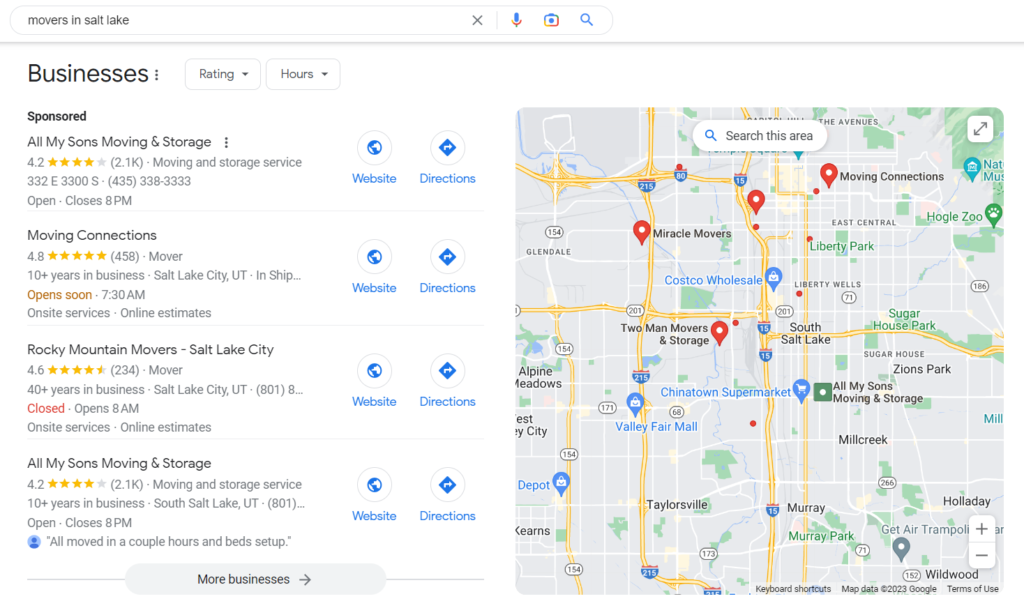
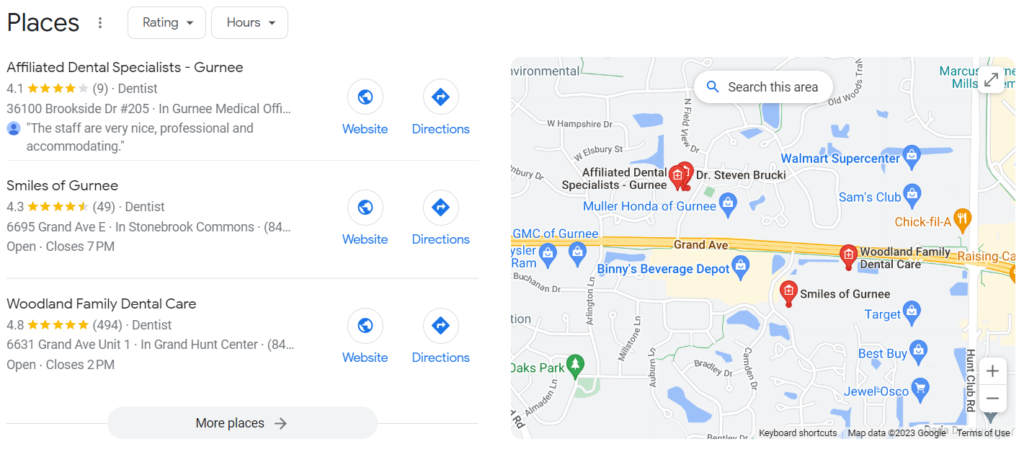
These local-focused search queries will bring up the Local Pack on the results page. If you have a Google Business Profile (and you absolutely should!), many of your website clicks will come through these local pack results.
Limits of Google Business Profile
But here’s the issue:
Local Pack results lean heavily on proximity. Meaning closer businesses will tend to rank higher than businesses far away.
Makes sense.
However, consider the consequences for our moving company example. Chances are, a Salt Lake City moving company wants to serve movers throughout the ENTIRE Salt Lake metro area. Not just those within a few-mile radius of their office.
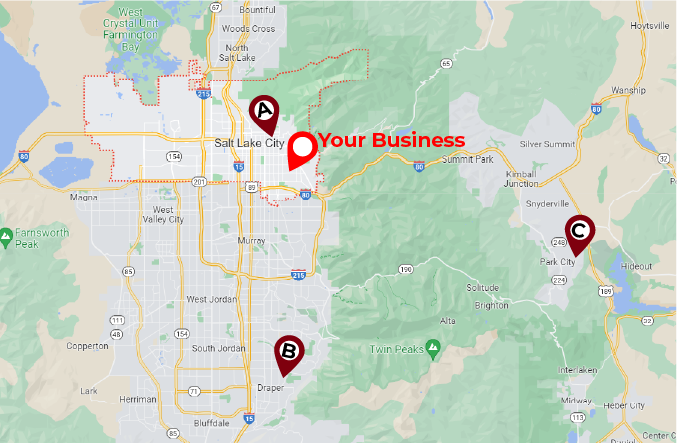
This is the problem: Your company wants to serve this entire map, BUT your Google Business Profile listing might only show up for someone searching from point A–next to your office in the heart of the city. And you probably won’t show up for someone searching from points B and C.
This puts a huge cap on the effectiveness of your Google Business Profile listings and severely limits the reach of your local SEO and digital marketing.
So now what?
Well, in order to rank for relevant search queries at points B and C, we need to tell Google that your business serves these areas as well.
And this is where service area pages come in.
Expanding Organic Reach
In order to reach users searching for moving companies out in Draper and Park City–points B and C–we’ll need to create pages that target geo-modified queries such as moving companies draper ut.
This allows us to target both (1) users searching for geo-modified queries like moving companies draper ut and (2) users searching for generic queries like moving companies from Draper. Without a service area page, we likely would not have ranked for either of those queries.

Service area pages without a physical location will typically show up in the organic results (as in the image above) instead of the local pack.
Within our SEO strategy, service area pages generally target more specific geo-modified queries that are lower in search volume but also less competitive and, therefore, easier to rank for.
How to Build Service Area Pages
Now that we know how these pages fit within our SEO strategy, it’s time to get down to the nitty-gritty. How do we best design and write service area pages for SEO?
Step 1: Identify your locations. If your business has multiple brick-and-mortar locations, this part is easy. Create a page for each location.
On the other hand, if you have a single location or run a service-based business such as a handyman, plumber, moving company, construction, home improvement, etc., you’ll create a page for each town you want to do business in.
Step 2: Write your pages. They should provide a relatively comprehensive overview of the services you provide. Best practices suggest at least 300 words split into manageable paragraphs with informative header tags.
Don’t be afraid to use (but not overuse) industry jargon. Nowadays, Google expects to see more than the keywords you’re trying to rank for. They want to see ‘secondary’ keywords that are related to your primary keywords.
For example, if we want our moving company to rank for movers draper ut, we need to include secondary keywords such as household movers, international relocation, furniture hauling, full-service moving, etc.
Check out some of the top pages that rank for your target keywords and see what kind of language they incorporate.
Step 3: Optimize your pages. Ensure your keywords appear in your URL, title, header, and meta descriptions. For example…
| Location | Draper, UT | Park City, UT |
| URL | example.com/areas-served/draper-ut-movers/ | example.com/areas-served/park-city-ut-movers/ |
| Title | Movers Draper, UT | My Moving Company | Movers Park City, UT | My Moving Company |
| H1 | Draper Moving Company | Park City Moving Company |
| Meta descriptions | My Moving Company’s team of Draper movers provides unbeatable relocation services… | My Moving Company’s team of Park City movers provides unbeatable relocation services… |
Step 4: Place a prominent call-to-action. There should be no question about how to engage your services. Whether it’s a big colorful CALL NOW button, a contact form, or directly scheduling service, clear calls-to-action will ensure higher conversion rates and more business.
Step 5: Implement linking schemes. Without links pointing to your page, Google’s crawlers have no way of finding them. Link to your location pages from a parent /areas-served/ page, from the main navigation menu, or in natural locations in page copy throughout your site.
Step 6: Add schema markup. This part is a bit more technical. If you have a dev team for your website, this is something they can help with.
Schema markup is little bits of code that tell search engines exactly what your page is about. For example, if you have your office address on your location page or in your website footer, you can add markup that explicitly tells Google that this is your business address.
This helps Google to make better sense of your page as well as provide information for Rich Results; additional information on the results page.
Local SEO is increasingly becoming an essential part of any digital marketer’s toolbox, and building a reliable location page setup is a key part of that. Leveraging local search features can help businesses reach potential customers, boosting their visibility and benefitting both the customer and the business itself.
Here is a bit about the concerns of duplicate content when building areas served pages.
With this in mind, it’s important to take time crafting quality location pages for maximum impact – something that will benefit you for years to come!