
Tag: ppc

  • Google Ads Phrase Match Types Compared in 2023

    Google Ads Phrase Match Types Compared in 2023

    Should You Switch to Broad Match Keyword?

    We have all been there. Going through our campaign recommendations and being told once again to change all our phrase and exact match keywords to broad match. Moving people to Broad Match Keywords seems to be one of google’s biggest goals as of late.

    Don’t worry, you are not the only one receiving this recommendation again and again. In fact, we manage a number of accounts and about 90% of them receive this recommendation repeatedly. 

    But is changing your keywords to broad match always the best move?

    Our short answer is no, switching all your keywords to broad match without analyzing them is not the best move, and here is why.

    Match Types Looking Different Nowadays

    If you’ve not managed the day-to-day of a campaign in a few years you may be out of the game and may have missed the memo that keyword match types are not what they were five years ago. In fact they are not even what they were a year ago.

    Google still has the core match types: broad match, phrase match, and exact match. However, their definitions have changed in the past few years and google completely went away with broad match modifiers in July 2021. We would argue that the new definitions for the match types have actually blurred the lines between them. 

    Let’s take a look at the new definitions for each match type and what that means for the search terms google pulls. 

    KEYWORD MATCH TYPE DEFINITIONS

    This is how google now defines each term: 

    Broad Match Keywords: The search term has to be related to the keyword but does not need to have the same meaning.

    Phrase Match Keywords: The Search Term has to include the same meaning as the keyword.

    Exact Match Keywords: The search term has to have the same meaning as the keyword.

    SOME EXAMPLES

    Keyword: Auto Shop
    Broad MatchPhrase MatchExact Match
    Car Towing company Purchase a FordCustom Auto Shopauto shop labor rates by stateAuto Shop 

    These rules make sense and are pretty straight forward, but here is where the waters get really muddied. Google has also introduced “close variants”. What does close variant mean? Well, it means that exact match keywords are no longer just exact match and phrase match Keywords are no longer just phrase match. Close variants are not a setting like phrase or exact match, rather if you set a keyword to exact match google might show search terms that are exact match “close variant”. Same goes for phrase match. Here are some examples of close variants for the same keyword “Auto Shop”.

    Keyword: Auto Shop
    Phrase Match “close variant”Exact Match “close variant”
    car accessory shop exhaust shop near me bmw performance shopauto store car shops auto places

    As you can see some of the phrase match “close variant” examples start to look similar to the broad match search terms. We have even seen the same search term appear as both a phrase match “close variant” and an exact match “close variant” for the same keyword. 

    Right about now is when you might be asking the same question that we were asking: Can you turn close variant matches off? Nope. Truly there is no off switch. There have been a handful of articles written about stopping google ads from showing close variants, but these articles all include tips on negative matching and account organization. Sadly none of them include a magic answer about where a hidden off switch button is. That being said, if you are interested in these other tactics Browser Media goes into detail on close variants and ways to prevent them.

    What Keyword Match Type Is Best For You?

    Now that we have looked at the match type definitions, let’s get into what this looks like in practice and assess if changing your exact match keywords to broad or phrase match is the best fit for your company. 

    Our biggest observation that companies need to look out for is the difference in search terms when using exact match vs phrase match for general industry keywords, like “automotive shop” or “Restaurants in Chicago”. The difference being that exact match will get you search terms with the same meaning as your keywords but phrase match will get you names of other companies.

    Let’s use “Restaurants in Chicago” as our example. Some exact match search terms would be “best chicago restaurants”, “chicago restaurant” and “must try restaurants in chicago”. Whereas, Phrase match search terms that include competitor names would include “portillos in chicago” and “cooper hawks Chicago”. 

     If your company doesn’t want to bid on competitor search terms, you will need to monitor the search terms closely and frequently negative match when using phrase match. If you don’t have the bandwidth for negative matching, then using more specific keywords or sticking to exact match keywords is the way to go.

    Don’t get us wrong, phrase match keywords will bring in non-competitor search terms as well which may in fact be helpful for your company, but you will need to be thorough in your negative keyword build-out. 

    So those are observations on the actual search terms that appear but what about numbers? How do the match types perform compared to one another? 

    Our campaigns, that span across industries, show consistently that exact match keywords out perform broad match and phrase match keywords in terms of CTR and Conversion rate. However exact match keywords also have a higher Cost Per Click. 

    Thus if your goal is number of ad impressions and brand awareness, broad match is the way to go. However, most of the time companies value conversions over impressions in which case the exact match keywords are your friend. 

    Our Recommendation

    Our biggest recommendation is to not switch all your keywords to broad match at once without doing your research and being prepared that your metrics might take a turn. Understand that making the switch from exact match to phrase match or phrase match to broad match is going to bring in search terms that your campaigns haven’t seen yet. 

    One option we recommend is to take it slow and try a few keywords at a time to see if you like the results of broad match keywords. From there, you can make the call if your other keywords should follow suit. 

    That being said, here are some questions to ask yourself before making the switch:

    Do I have the time to sort through search terms and build out negative keyword lists?

    What are my KPIs? Do I value conversion rates or impressions?

    Do I want to bid on competitor terms?

    Do I have the time to do deep dives into individual keyword performances?

    Final Take Away

    Don’t be pressured by Google recommendations to change all your keywords to broad match without understanding what that is going to do to your campaigns.  Remember, you know your account. You know your keywords and your metrics. You can make the best decision for your campaigns, whether it is taking Google’s recommendation or once again hitting that pesky dismiss button and keeping your exact match keywords.

  • Is Paid Advertising Evil?

    Is Paid Advertising Evil?

    Are Search & Display Ads Evil?

    In the year 2023, we have all experienced ad overload from a company. That’s right, you viewed a product one time on Nike’s website, now, every time you open up Facebook, BOOM Nike ad. Okay open up Instagram, BOOM an in-feed Nike ad. Surely there won’t be a Nike ad while reading your local morning news website. Wrong. There, on the side, is a Nike banner ad. These ads even find their way onto your solitaire app. 

     While some people do actually find these ads helpful, others of us feel like we are being bombarded or even stalked by these companies. Why are they showing up everywhere? Are they invasive or helpful?

    So, is ALL paid advertising Evil? 

    Truthfully our answer is no, paid advertising isn’t usually evil and in fact can be used for a lot of good.  And yes this is coming from someone who makes a living running these ads but bear with us here. 

    We understand that companies have their own view on paid advertising. Some love it and will pour all their money into running +50 campaigns and other companies fear that paid advertising comes off as sleazy and inauthentic to consumers. 

    But with paid advertising there are so many forms of targeting and placements, that labeling them all the same way isn’t the best route. We have created an Authenticity scale that uses two metrics, control and helpfulness. The Goal of the Authenticity scale is to help advertisers determine what their comfort zone is when it comes to paid advertising. 

    First we are going to do a brief recap of search ads and display ads. Next we will outline what the Authenticity Scale is and how to use it. Finally, we will break down a handful of examples and place them on the scale to help you get the hang of it. 

    SEARCH vs. DISPLAY ADS

    Let’s quickly layout 2  kinds of Google ads, search and display ads, before we dive into the Authenticity of advertising tactics. 

    1. First, Search ads. Search Ads appear alongside organic results when a consumer enters a query in the search engine. Advertisers bid on search terms and if those terms are queried then their ad may appear. For example, if Nike bid on “Running shoes” and someone searches “Best tennis shoes for running” then they will be met with a Nike ad like the one below:
    1. Display ads. Display ads can appear in apps, in video, or as banner ads on websites. They will look something like this: 

    Now that we have nailed down two ad types, let’s jump into our Authenticity Scale.

    ADVERTISING AUTHENTICITY SCALE

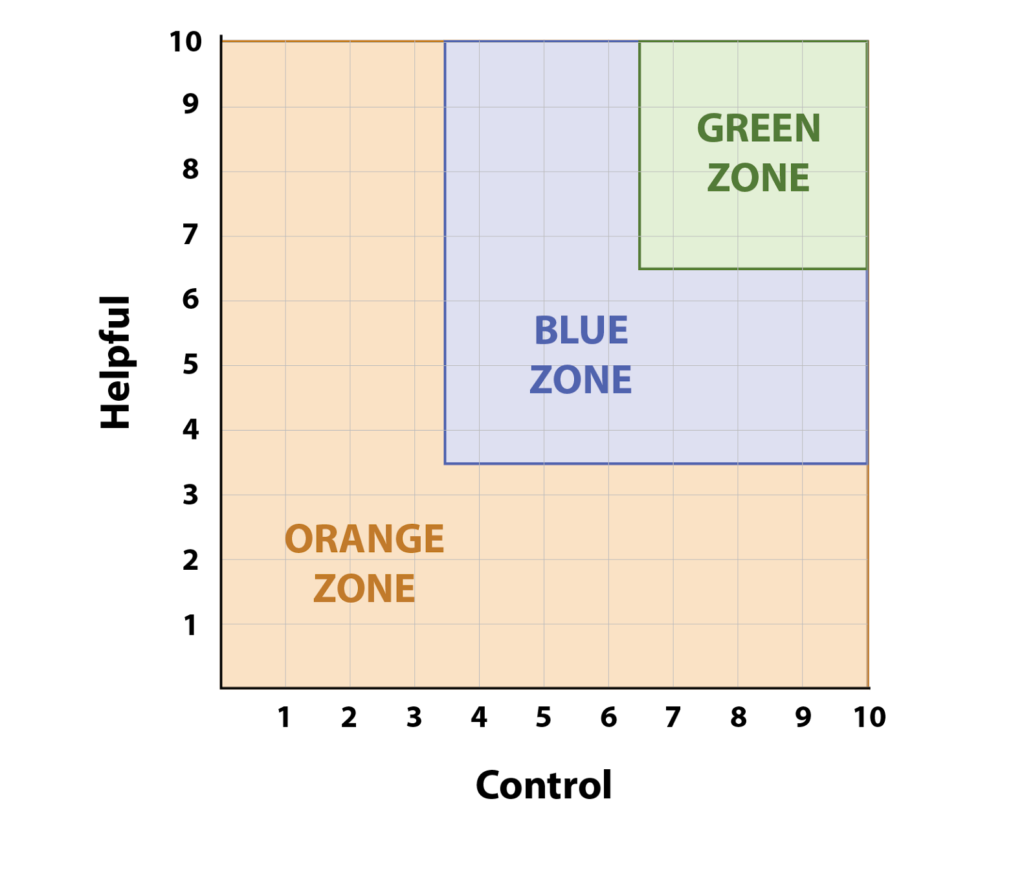
    Paid advertising comes in many forms. In order to determine an ad’s Authenticity, we are going to utilize two different scales.

    1. Control: The control an advertiser has over who, where, how a consumer is receiving ads. 
    2. Helpfulness: The extent to which an ad is helpful to the consumer. 

    When using this two point scale ads are going to fall into a Green Zone, Blue Zone, and Orange Zone. 

    Ads that are high on both control and helpfulness are going to be in the Green Zone. The Green Zone consists of ads that will almost always be beneficial for both company and consumer.  

    Next are our Blue Zone ads, which are ads that will be in the middle of either control or helpfulness. These ads are usually still beneficial for company and consumer, though seeing as they fall in the middle of one or both of the scales we can’t be certain about either customers intent or placement of ads. 

    Now for our Orange Zone ads. Orange Zone ads will fall low on one or both of the scales. Just because ads are in the Orange Zone doesn’t mean they are evil, however, we understand there is a time and a place for them. We recommend using Orange Zone ads when the primary focus is for brand awareness rather than high conversion rates. 

    Let’s look at this on a graph.

    Advertising Authenticity Score

    PUTTING THE GRAPH TO WORK

    Now let’s put this graph to work and plot where different advertising strategies fall.

    SEARCH ADS IN THE ORANGE ZONE:

    I am going to play devil’s advocate right off the bat, and give an example of advertising that is closer to the ~evil~ side, or inauthentic side, of advertising.

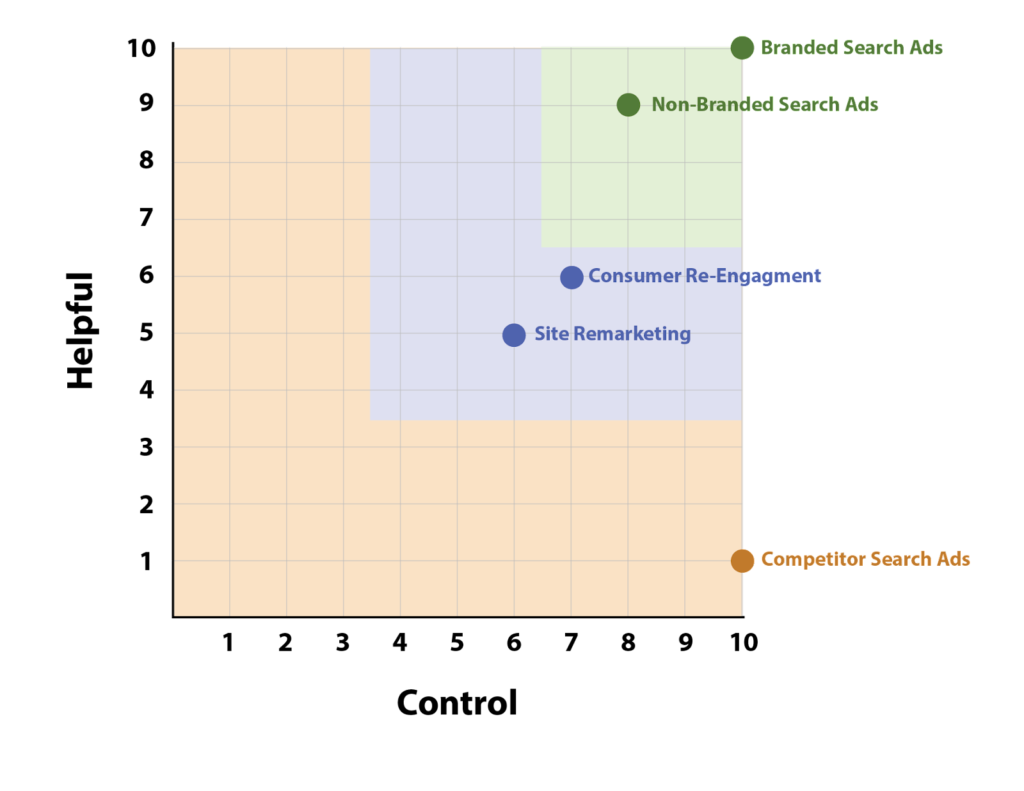
    Competitor Search ads. For a company like Nike, this would be bidding on terms like “Adidas Shoes”. On our first scale, Control, competitor search ads actually rank very high. We would know where these ads are showing and for the exact search terms they are showing for. 

    On our second scale, Helpfulness, Competitors Search ads rank very low placing them in the Orange Zone. If a consumer searches, Adidas shoes, chances are they know what they want and it’s not Nike Shoes. With this method of advertising, the goal is less about being helpful and more about disrupting a consumer’s actions. Getting Nike’s name in their last minute, one, probably won’t have a high return on investment, and two, is disregarding the consumers preferences and is thus more invasive.   

    Therefore, Competitor Search ads are in our bottom right corner in the Orange Zone.

    Advertising Authenticity Score

    SEARCH ADS IN THE GREEN ZONE:

    Now let’s look at Search ads that are on the flip side of the Helpful scale in our Green Zone.

    Branded Search Ads. Pretty self explanatory, but Branded Search ads re when a company bids on its own name. For example Nike bidding on  “Nike” or “Nike Shoes”.  

    • Control: These ads like Competitor Search ads rank high on control. When bidding on branded terms you have a narrow and controlled pool of search terms your ads are showing up for. 
    • Helpfulness: Unlike Competitor Search ads, Branded Search ads are high on Helpfulness. When a consumer is searching for your company, they are point blank looking for you and exactly you. Therefore you want to be front and center for them when they search. 

    Non-Brand Search Ads. Some examples of Non-Brand Search keywords for Nike are “Athletic shoes”, “gym shoes”, or “best sneakers for running”. 

    • Control:In terms of control Non Brand Search ads rank just below Branded Search Ads. The only reason there is a little less control is because there is a wider pool of search terms.
    • Helpfulness: Believe it or not, non brand search ads we still classify as high on the helpfulness scale. If a consumer is searching for a product and just doesn’t know the name of a company that supplies said product they are still information gathering. 

    Let’s go back to Nike but pretend that this consumer who is searching for running shoes does not know any of the big brands. The consumer searches for “running shoes”. They are looking for a high quality product, so why not Nike. Whether Nike is bidding on these terms or not other people will be. Therefore, even if Nike is the first organic result, they won’t be the first company that consumers see because there will be ads at the top. If Nike is the best option for the consumer and they simply don’t see them because their organic result is buried under ads then both consumer and company are missing out. Thus you want to be there as an option in their search for information.

    Since both our Brand and Non-Brand Search ads ranked high on Control and Helpfulness, that places them right in our Green zone. 

    Advertising Authenticity Score

    DISPLAY ADS IN THE BLUE ZONE

    Let’s dive into which Google Display ads fall into our Blue Zone. 

    Consumer Renegament Display ads: targeting previous consumers based on email lists. This is not people who have simply visited the site but people who have actually purchased the product or service.

    • Control: Medium High. Since this ad type is based on email lists from the company we know exactly who we are targeting. The only reason it is bumped down a few points is because of the nature of display ads. In this scenario we aren’t picking specific placements on the google display network so the ads could be running on a variety of sites and apps.
    • Helpfulness: Medium. Truthfully this one depends on the product being sold. For instance if the product being sold is a Refrigerator, consumers probably aren’t going to be in the market for a new refrigerator for many more years. Therefore hitting them with a display ad 3 months after purchase isn’t helpful.ing.  

    However if the product being sold is a face wash, hitting the consumer with an ad 3 months after initial purchase to remind them to place a new order before they run out can be very helpful. We know these people have used the company’s product or service, and assuming a positive experience, they most likely like the company and would purchase again. 

    Site Remarketing Display Ads: targeting those who have visited the companies site without purchase.

    • Control: Medium. We know for the most part who is being hit with the ads but it’s a wider pool than consumer re-engagement and it’s on the Display network.
    • Helpfulness: Medium. Hopefully the consumer is at least interested in the company, hence spending time on the site. However we don’t fully know their motives for being on the site or their impressions of the company after the visit. 

    Blue Zone ads tend to be reconnecting with people who are at least aware of the company’s name. 

    Advertising Authenticity Score

    DISPLAY ADS IN THE ORANGE ZONE

    We talked about Competitor Search ads being in the Orange Zone but let’s finish filling this zone out. 

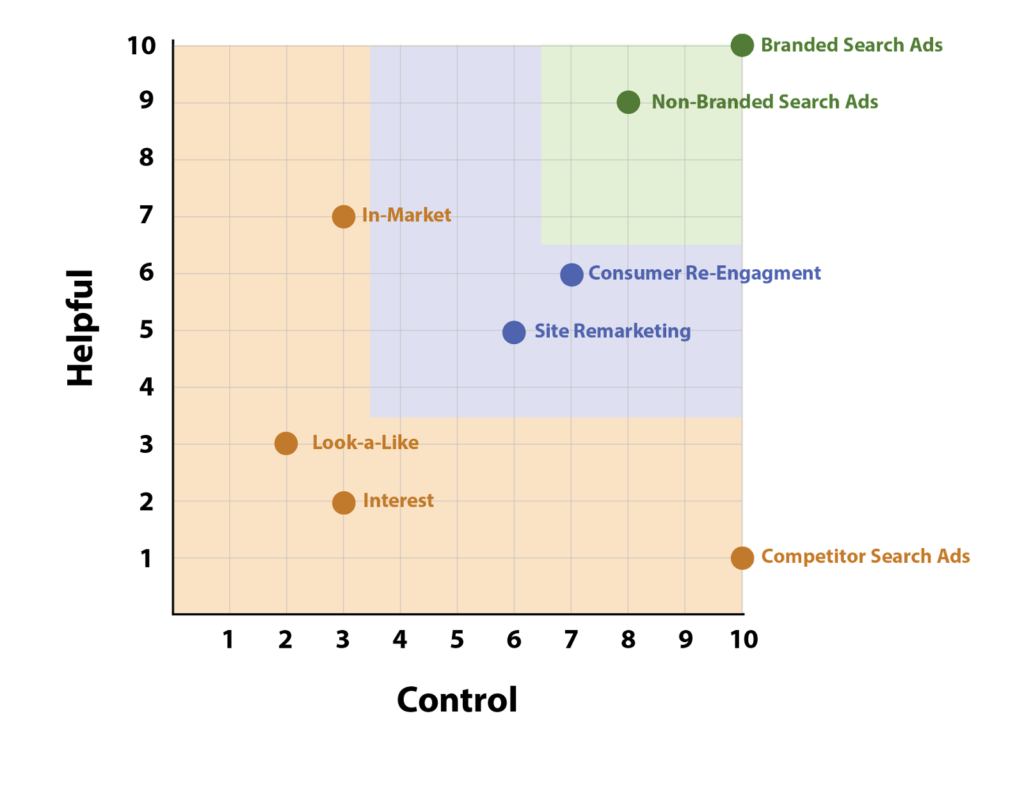
    In Market Display: Using Google’s AI, we are targeting those who are in the market for a product. For example Nike’s In Market Display ads would be targeted at people who are “in the market” or looking to purchase running shoes. Again, who is in the market for new running shoes is determined by google not the advertiser. 

    • Control: Low. The nature of display ads already knocks it down a few pegs, but the second reason it loses points is because we are relying on google’s targeting metrics. What exactly makes someone “in market” for new running shoes? We as advertisers have less control over who sees the ads when google is at the wheel. 
    • Helpfulness: Medium high. Since we are targeting people who are in-market or actively looking for a new pair of running shoes, showing Nike’s name is hopefully beneficial. 

    Interest Display Ads: Using Google’s AI to target people who have interests that would align with a company’s target market. Using Nike again as an example, they could target people with interests in playing sports, running marathons, or even coaching.  

    • Control: Medium low. We have an idea of who is getting targeted but again it’s a very wide pool that google has created. Also, as stated before, the display network naturally has less control than search ads.
    • Helpfulness: Low. Honestly with this group we truly don’t know if they are interested in running shoes at the moment, they might be swimmers or love their new balances. The positives for running ads like this would be more for brand recognition. Getting your company’s name out there so that they are remembered when the consumer is looking for your product even if they aren’t in need of it at the moment. 

    Look Alike Display Ads: Target people who match a profile (lookalike) of those who have purchased a product or used your service. Lookalikes are again determined by google’s AI.

    • Control: Low. Again, this is reliant on what google demes a lookalike. Maybe Because we don’t know what metrics google uses to compare, we deem these pretty low on control.
    • Helpfulness: Medium low. Going on the idea that google is in fact showing us to quality consumers we rank this medium low. Ideally they will be similar to previous consumers but that’s not to say they are in the market for your service right now. 

    As we state early, just because an ad is in the Orange Zone doesn’t mean it is evil and invasive by nature. For our Green and Blue Zones we are looking for conversions and a lower cost./conversion. For these Orange Zones ads on the other hand it’s best to have a totally different goal. That goal being brand awareness. Many of these ad types tend to have high impressions which is a great metric to use when trying to measure the success of a brand awareness campaign. 

    Advertising Authenticity Score

    WRAPPING UP

    We went over a lot of ad types and tactics today and, let’s be honest, that’s just breaking the surface, since we didn’t even touch on Social media advertising. With all the different kinds of targeting and placements out there, it can get overwhelming for a company to decide what direction they want to take and what kind of advertising aligns with the values of their company. By looking at each tactic individually and using this two point scale companies can better understand if said tactic fits within their comfort zone. 

    Now what about our very first example of one person getting bombarded with every ad on every network for Nike Tennis Shoes? Yeah….we would consider this the closest thing to invasive evil advertising. Though we would also be lying if we said these ads have never worked on us.  

  • Display Campaigns & Brand Awareness

    Display Campaigns & Brand Awareness

    Today, we’re looking at how to build brand awareness with display advertising. This can be a very nuanced conversation and it is important your team is on the same page from the jump. Some decisions that need to be made from the start are, what campaign and ad types to use and what KPIs will be used to measure the success of a brand awareness campaign. 

    Here we are going to break down a few ways to set up and measure a brand awareness campaign. 

    Why Display Campaigns for Brand Awareness?

    Using a display campaign alongside a search campaign is a great tactic for a brand awareness objective. 

    These two campaign types will work side by side to support one another. When solely using search campaigns you are only getting in front of people who are actively searching for your product or service. 

    However, when using display campaigns and curated audiences your ads will appear in front of potential customers who might not even know your product or service exists. Thus expanding your potential and actual reach exponentially. 

    Here is where your search ads come in handy to support your display ads. 

    A potential customer who viewed your display ad may click directly on your ad and be taken straight to your sight. Great! 

    However, they might not be ready to buy just yet. Then a few days, weeks, or even months later, when they are ready to buy or looking for more information, they can search for your company and be met with a search ad. 

    Perfect! The tag team ad types did their job. Now, your search ads may come into play much quicker. 

    Those who are distrusting of display ads may pop over and do a quick google search right away for your company. Again being met with your search ads. So don’t be surprised if you see an increase in your search campaign impression and make sure to budget accordingly to pick up the new traffic.    

    Measuring the Success of a Brand Awareness Campaign

    Being on the same page regarding Key Performance Indicators is crucial for any campaign, especially for a brand awareness campaign. 

    That’s because usually, brand awareness campaigns aren’t using conversion rate or cost per conversion as their success metrics, instead oftentimes using impressions, clicks, and CPM. 

    This can be a tricky adjustment if your team isn’t used to using these KPIs. 

    If your goal is to see an increase in impressions and clicks for a brand awareness campaign there is also a good chance that conversion rates will go down and cost per conversion will go up, which can make people uneasy. 

    We get that. 

    Usually, you want a higher conversion rate and a lower cost per conversion, which is why your KPIs need to be straightened out ahead of time. 

    So, why is a display campaign with a brand awareness objective worth it? 

    Well, it’s true, display ads, unlike search ads, aren’t necessarily reaching people who are actively searching for your product or service thus your click-through rate and conversion rate are logically going to decrease. 

    That being said, brand awareness campaigns are all about the long term pay off. Display ads aren’t reaching people actively searching for your product or service, no, but hopefully when people are in need of your product or service your company will come to mind or at least be a recognizable name when they search. 

    Keep in mind this need could be in 2 weeks, 2 months or even 2 years. Therefore you want to increase your impressions and clicks so you are getting in front of as many new customers as possible.

    This leads us to another good indicator of a successful brand awareness campaign. 

    Rather than zeroing in and looking at the impressions and clicks of one individual campaign try zooming out and looking at branded queries as a whole. This is relevant for both paid ads and organic searches. Are more people searching for your company name? 

    For example, when running a Brand Awareness Campaign for 10 weeks we saw an 88% increase in paid branded search term queries and a 110% increase in organic branded search queries. 

    We saw that our increase in branded awareness spend strongly correlated with the increase in branded search queries. This benefit would not have been something that was noticed if we isolated ourselves to only looking at the display ad metrics. Thus, once again it is important to take a step back and look at the whole picture when running a brand awareness campaign.  

    All companies and campaigns are different. Running ads and goals can be very nuanced. It is crucial to have the important conversations about ad types and KPIs right off the bat to ensure that your campaign runs smoothly towards your team’s goals.