
Category: SEO News and Information

  • Boost Your Plumbing Business: Digital Marketing Strategies

    Boost Your Plumbing Business: Digital Marketing Strategies

    Ready to elevate your plumbing business? Discover effective digital marketing strategies that will attract new customers and boost your bottom line.

    Boost Your Plumbing Business: Digital Marketing Strategies

    Ready to elevate your plumbing business? Discover effective digital marketing strategies that will attract new customers and boost your bottom line.

    Understanding Digital Marketing for Plumbing Businesses

    In today’s digital age, marketing your plumbing business effectively requires more than just traditional advertising methods. Digital marketing has become a crucial element for businesses to reach out to their potential customers, engage with existing ones, and ultimately grow their bottom line. The internet offers a plethora of opportunities to showcase your services, and knowing how to leverage these opportunities can set you apart from the competition.

    Digital marketing encompasses a wide range of strategies including search engine optimization (SEO), social media marketing, email marketing, and online reputation management. Each of these components plays a vital role in creating a comprehensive marketing plan that can help you attract, engage, and convert potential customers. By understanding and implementing these strategies, plumbing businesses can effectively reach their target audience and grow their customer base.

    As a plumbing business owner, it’s essential to recognize the importance of adapting to the digital landscape. With more people turning to the internet to find services, having a strong online presence can make a significant difference in how potential customers perceive and choose your business. Digital marketing is not just about having a website; it’s about creating a holistic approach that encompasses various online channels to drive traffic, generate leads, and build brand loyalty.

    Importance of Online Presence in the Plumbing Industry

    The significance of having a robust online presence cannot be overstated, especially in the plumbing industry. When people face plumbing issues, they often turn to search engines to find local plumbers who can address their needs promptly. If your business does not appear in these search results, you are missing out on a substantial number of potential customers.

    An online presence also builds credibility and trust. Customers are more likely to trust a business that has a professional website, positive online reviews, and an active social media presence. These elements show that your business is legitimate and capable of delivering quality services. In contrast, a lack of online presence can make potential customers question the reliability and professionalism of your business.

    Moreover, having an online presence allows you to reach a wider audience. Unlike traditional marketing methods that are often limited by geography and reach, digital marketing can help you connect with people beyond your immediate locality. This can be particularly beneficial for specialized plumbing services that may not have a high demand in your local area but could attract customers from neighboring regions.

    Key Digital Marketing Strategies for Plumbers

    Implementing effective digital marketing strategies is essential for plumbing businesses to thrive in a competitive market. One of the first steps is to build a user-friendly website that reflects your brand and provides essential information about your services. Your website should be optimized for both desktop and mobile devices to ensure a seamless user experience.

    Search engine optimization (SEO) is another critical strategy. By optimizing your website and content for search engines, you can improve your visibility in search results, drive organic traffic to your site, and attract potential customers who are actively searching for plumbing services. This involves keyword research, on-page SEO, link building, and creating high-quality content that addresses the needs and concerns of your target audience.

    Social media marketing is also a powerful tool for plumbers. Platforms like Facebook, Instagram, and Twitter allow you to engage with your audience, showcase your work, and build a community around your brand. Regularly posting informative and engaging content, responding to comments and messages, and running targeted ads can help you reach a larger audience and generate more leads.

    Building a User-Friendly Plumbing Website

    Your website is often the first point of contact between your business and potential customers, so it’s crucial to make a positive impression. A user-friendly website should be easy to navigate, visually appealing, and provide all the necessary information that customers might be looking for. This includes details about your services, contact information, pricing, and customer testimonials.

    One of the key aspects of a user-friendly website is its loading speed. A slow-loading website can frustrate users and lead them to abandon your site in favor of a competitor’s. Ensuring that your website loads quickly on both desktop and mobile devices can significantly improve user experience and reduce bounce rates. Additionally, having a responsive design that adapts to different screen sizes can enhance usability and accessibility.

    Another important factor is the website’s layout and design. A clean, well-organized design with clear calls-to-action (CTAs) can guide visitors through your site and encourage them to take the desired actions, such as booking a service or contacting you for more information.

    Incorporating high-quality images and videos can also make your website more engaging and help potential customers get a better sense of your work.

    Search Engine Optimization (SEO) for Plumbing Services

    SEO is a fundamental component of digital marketing that can significantly impact your plumbing business’s online visibility. By optimizing your website and content for search engines, you can improve your rankings in search results and attract more organic traffic. This involves a combination of on-page and off-page SEO techniques.

    On-page SEO focuses on optimizing individual web pages to rank higher in search results. This includes using relevant keywords in your content, meta titles, and descriptions, as well as optimizing your images and ensuring that your website is mobile-friendly. Conducting thorough keyword research can help you identify the terms and phrases that potential customers are using to search for plumbing services, allowing you to tailor your content accordingly.

    Off-page SEO, on the other hand, involves activities that take place outside of your website, such as building backlinks from reputable sites, social media marketing, and online reputation management. Backlinks from high-authority websites can boost your site’s credibility and improve its search engine rankings. Additionally, creating valuable content that other websites want to link to can drive more traffic to your site and enhance your online presence.

    Utilizing Local SEO to Attract Nearby Customers

    For plumbing businesses, local SEO is particularly important as it helps you target customers in your specific geographic area. Local SEO involves optimizing your online presence to attract more business from relevant local searches. This includes claiming and optimizing your Google My Business listing, building local citations, and getting positive reviews from satisfied customers.

    Claiming your Google My Business listing is a crucial step in local SEO. This allows your business to appear in local search results and on Google Maps, making it easier for potential customers to find you. Make sure to provide accurate and up-to-date information, including your business name, address, phone number, and hours of operation. Adding photos and encouraging customers to leave reviews can also enhance your listing and attract more local customers.

    Building local citations involves getting your business listed in online directories and local business listings. Consistency is key here, so ensure that your business information is accurate and consistent across all platforms. Local citations can improve your visibility in local search results and help potential customers find your business more easily.

    Leveraging Social Media for Plumbing Business Growth

    Social media platforms offer a unique opportunity for plumbing businesses to connect with their audience, build brand awareness, and generate leads. By creating and sharing valuable content, engaging with your followers, and running targeted ads, you can leverage social media to grow your plumbing business.

    One of the benefits of social media marketing is its ability to humanize your brand. By sharing behind-the-scenes content, showcasing your team, and highlighting customer success stories, you can create a more personal connection with your audience. This can build trust and loyalty, making customers more likely to choose your business for their plumbing needs.

    Running targeted ads on platforms like Facebook and Instagram can also help you reach a larger audience and generate more leads. These platforms offer advanced targeting options that allow you to reach people based on their location, interests, and behaviors. By creating compelling ad campaigns and experimenting with different ad formats, you can attract more potential customers and drive traffic to your website.

    The Role of Online Reviews and Reputation Management

    Online reviews play a significant role in shaping the perception of your plumbing business. Positive reviews can build trust and credibility, while negative reviews can deter potential customers. Therefore, managing your online reputation is crucial for attracting new customers and maintaining a positive image.

    Encouraging satisfied customers to leave reviews on platforms like Google, Yelp, and Facebook can enhance your online reputation. Make it easy for customers to leave reviews by providing links on your website, in follow-up emails, and on your social media pages. Responding to reviews, both positive and negative, shows that you value customer feedback and are committed to providing excellent service.

    Negative reviews are inevitable, but how you handle them can make a significant difference. Addressing negative reviews promptly and professionally can demonstrate your commitment to customer satisfaction and potentially turn a dissatisfied customer into a loyal one. Apologize for any issues, offer solutions, and take the conversation offline if necessary to resolve the matter privately.

    Effective Email Marketing for Plumbing Businesses

    Email marketing is a powerful tool for plumbing businesses to stay in touch with their customers, promote their services, and generate repeat business. By building an email list and sending targeted, personalized emails, you can nurture relationships with your customers and keep your business top of mind.

    One of the key aspects of effective email marketing is segmentation. By segmenting your email list based on factors such as customer location, service history, and engagement level, you can send more relevant and personalized emails. This can increase open rates, click-through rates, and overall engagement with your emails.

    Creating valuable content for your emails is also important. This can include tips and advice on plumbing maintenance, special offers and promotions, company updates, and customer success stories. Providing valuable content can keep your subscribers engaged and more likely to choose your business when they need plumbing services.

    Measuring Success: Key Metrics to Track Your Marketing Efforts

    To ensure that your digital marketing efforts are effective and delivering the desired results, it’s essential to track key metrics and analyze your performance. This can help you identify what’s working, what’s not, and where you can make improvements.

    Some of the key metrics to track include website traffic, conversion rates, bounce rates, and customer acquisition costs. Analyzing website traffic can help you understand how many people are visiting your site, where they are coming from, and which pages they are visiting. Conversion rates can indicate how well your website and marketing efforts are turning visitors into leads and customers.

    Social media metrics such as engagement rates, reach, and follower growth can provide insights into the effectiveness of your social media marketing efforts. Email marketing metrics like open rates, click-through rates, and unsubscribe rates can help you gauge the success of your email campaigns. By regularly monitoring these metrics and making data-driven decisions, you can optimize your digital marketing strategies and achieve better results for your plumbing business.

  • Top Chicago SEO Marketing Companies for Business Growth

    Top Chicago SEO Marketing Companies for Business Growth

    Unlock your business potential with Chicago’s top SEO marketing companies. Discover how expert strategies can propel your growth in today’s digital landscape.

    Importance of SEO for Business Growth

    In today’s digital age, having a robust online presence is essential for any business looking to achieve sustainable growth. Search Engine Optimization (SEO) plays a crucial role in this, as it enhances the visibility of a website on search engines like Google. When executed effectively, SEO strategies can drive organic traffic to your site, increasing the chances of converting visitors into customers. The importance of SEO cannot be overstated, especially for businesses in competitive markets like Chicago where standing out is imperative.

    SEO works by optimizing various elements of a website, including content, keywords, and backlinks, to improve its ranking on search engine results pages (SERPs). The higher your website ranks, the more likely potential customers are to find you. This increased visibility not only drives traffic but also builds credibility and trust. Consumers tend to trust businesses that appear on the first page of search results, associating higher rankings with quality and reliability. Therefore, investing in SEO is not just about getting more clicks; it’s about establishing your brand’s authority in the market.

    Moreover, SEO offers one of the highest returns on investment (ROI) compared to other digital marketing strategies. Unlike paid advertising, which provides immediate but short-term results, SEO is a long-term strategy that continues to yield benefits over time. Once your website achieves a high ranking, maintaining that position requires less investment compared to the initial optimization efforts. This makes SEO a cost-effective way to ensure consistent traffic and growth for your business. In a bustling city like Chicago, where competition is fierce, leveraging SEO can give you the edge you need to thrive.

    Key Factors to Consider When Choosing an SEO Company

    Choosing the right SEO company is a critical decision that can significantly impact your business’s online success. The first factor to consider is the company’s experience and expertise. An experienced SEO firm will have a proven track record of helping businesses achieve higher rankings and increased traffic. Look for case studies or testimonials that showcase their success stories. Additionally, consider the industries they have worked in; a company that understands your specific market will be better equipped to develop effective strategies tailored to your needs.

    Another important factor is the range of services offered. SEO is multifaceted, involving on-page optimization, off-page strategies, content creation, and technical SEO. A comprehensive SEO company should offer a full suite of services to address all aspects of optimization. This ensures that your website is fully optimized from every angle, maximizing your chances of achieving higher rankings. Additionally, inquire about their approach to SEO; the best companies will use ethical, white-hat techniques that comply with search engine guidelines, avoiding any tactics that could result in penalties.

    Transparency and communication are also crucial when selecting an SEO company. A reputable firm will provide clear, detailed reports on their progress and the results they are achieving for your business. Regular updates and open lines of communication ensure that you are always informed about the status of your SEO campaigns. It’s also important to have a dedicated account manager or point of contact who can answer your questions and address any concerns promptly. This level of transparency builds trust and ensures that you and your SEO partner are aligned in your goals and expectations.

    Services Offered by Leading SEO Companies

    Leading SEO companies offer a wide range of services designed to improve your website’s visibility and performance. One of the core services is on-page SEO, which involves optimizing individual web pages to rank higher on search engines. This includes keyword research and integration, meta tag optimization, and improving the overall quality of content. Effective on-page SEO ensures that your website is relevant to the search queries of your target audience, making it easier for potential customers to find you.

    Off-page SEO is another critical service provided by top SEO firms. This involves activities that occur outside your website but still impact its ranking. The most common off-page SEO tactic is building high-quality backlinks from reputable websites. These backlinks act as endorsements, signaling to search engines that your site is trustworthy and authoritative. Additionally, off-page SEO can include social media marketing, influencer outreach, and guest blogging. These strategies help to increase your website’s visibility and drive more traffic from various online channels.

    Technical SEO is also a key service offered by leading companies. This focuses on the backend aspects of your website, ensuring that it is easily crawlable and indexable by search engines. Technical SEO services can include improving site speed, ensuring mobile-friendliness, and fixing any broken links or errors. A technically sound website not only improves your search engine rankings but also provides a better user experience, which can lead to higher engagement and conversion rates. By addressing all these aspects, top SEO companies ensure that your website is fully optimized for success.

    Future Trends in SEO and Digital Marketing

    The landscape of SEO and digital marketing is constantly evolving, driven by advancements in technology and changes in consumer behavior. One of the most significant future trends is the increasing importance of artificial intelligence (AI) and machine learning. Search engines like Google are continually improving their algorithms to provide more accurate and relevant search results. AI-driven tools can analyze vast amounts of data to identify patterns and trends, allowing businesses to fine-tune their SEO strategies for better results. Companies that leverage AI in their SEO efforts will have a competitive edge in understanding and meeting customer needs.

    Voice search is another trend that is reshaping the way people interact with search engines. With the rise of smart speakers and virtual assistants like Amazon’s Alexa and Google Assistant, more users are conducting searches using voice commands. This shift requires businesses to adapt their SEO strategies to focus on natural language processing and long-tail keywords. Optimizing for voice search can improve your chances of appearing in featured snippets and voice search results, driving more traffic to your website.

    The growing emphasis on user experience (UX) is also a trend that will continue to influence SEO and digital marketing. Search engines are increasingly prioritizing websites that offer a seamless, intuitive user experience. Factors such as page load speed, mobile-friendliness, and easy navigation are becoming critical ranking factors. Businesses must focus on creating websites that not only look good but also perform well across all devices. By prioritizing UX, companies can improve their search engine rankings and provide a better experience for their visitors, ultimately leading to higher engagement and conversions.

    Comparing SEO Pricing Models in Chicago

    When it comes to investing in SEO services, understanding the various pricing models is crucial to making an informed decision. In Chicago, SEO companies typically offer a range of pricing structures to accommodate different business needs and budgets. The most common pricing models include hourly rates, monthly retainers, and project-based pricing. Each model has its pros and cons, and the best choice depends on your specific goals and resources.

    Hourly rates are often preferred by businesses that need specific, short-term SEO tasks completed. This model provides flexibility, allowing you to pay only for the hours worked. However, it can be challenging to predict the total cost, as the time required for SEO tasks can vary. Monthly retainers are a popular choice for businesses seeking ongoing SEO support. This model involves a fixed monthly fee, providing a predictable budget and consistent optimization efforts. Retainers are ideal for long-term projects, as they ensure that your website receives continuous attention and improvement.

    Project-based pricing is another common model, suitable for businesses with well-defined SEO goals. This involves a one-time fee for a specific project, such as a website audit or a complete SEO overhaul. Project-based pricing provides clarity on the scope and cost of the work, making it easier to manage your budget. However, it may not be the best option for businesses needing ongoing optimization. By understanding these pricing models, you can choose the one that aligns with your business needs and ensures that you receive the best value for your investment.

    Conclusion: Choosing the Right SEO Partner for Your Business

    Choosing the right SEO partner is a critical decision that can significantly impact your business’s online success. In a competitive market like Chicago, finding an SEO company that aligns with your goals and values is essential. Start by evaluating their experience and expertise, ensuring they have a proven track record of delivering results. Look for a company that offers a comprehensive range of services, from on-page and off-page SEO to technical optimization. This ensures that all aspects of your website are optimized for success.

    Transparency and communication are also crucial factors to consider. A reputable SEO firm will provide regular updates and detailed reports on their progress, keeping you informed about the status of your campaigns. Open lines of communication ensure that any questions or concerns are addressed promptly, fostering a strong working relationship. Additionally, consider the pricing models offered by the SEO company. Choose a model that aligns with your budget and provides the best value for your investment.

    By taking the time to research and evaluate potential SEO partners, you can find a company that not only meets your needs but also helps you achieve your business goals. Investing in the right SEO services can unlock your business potential, driving growth and success in today’s digital landscape. With the right strategies and support, your business can thrive in the competitive Chicago market.

  • Large Language Models and AI for Local Businesses

    Large Language Models and AI for Local Businesses

    It is mind-boggling to consider how fast AI has become part of our lives. From the obvious to the unseen, Artificial Intelligence is imbued in so much of what we do that we can’t go a day, or even an hour, without being touched by it.

    In light of this, the challenge for business owners is to draft a plan to leverage AI through AI Optimization (AIO), understand how it integrates with existing channels such as SEO, and decide where to allocate resources.  

    This challenge is compounded by the speed at which AI has progressed, the volume of press companies generate (which may be a distraction), and the new paradigm AI introduces in consumer interactions.

    One key to developing an AI strategy is to recognize that the type of information required to complete a task/request can vary significantly from one request to another. As a result, the sources used to inform the AI’s response for each request will vary.

    Consider two types of consumer requests. 

    1. What pickup truck is better, the Ford F-150 or the Dodge Ram, for personal use and hauling gardening items like plants, dirt, and tools?
    1. Where can I buy a Ford F-150 near me?

    The first request will be answered through a mix of manufacturer sites’ product pages, consumer reports, product reviews, social media, and forums (such as Reddit). It will combine product specifications, industry reviews, and user threads for each product to form quantitative and qualitative narratives as part of the response. The information will be primarily from the LLMs.

    The second request will be satisfied through a few primary sources: Manufacturers’ dealer locators, Google Business Profiles, business reviews on sites like Google & Yelp, and the company’s website. The response will be primarily objective: location/distance, services/products sold, and a consistent history of strong customer ratings. This information will come from a combination of the LLM training and Discovery.

    As companies develop their AIO strategy, they must first determine the customer journey and how to meet customers along that path.

    LLMs/AI vs SEO

    AI and Large Language Models (LLMs) offer a very different approach to analyzing and presenting information than the search engines we are accustomed to. While consumer adoption of AI generally involves applications and behaviors that mimic traditional search, AI’s technology and capabilities offer much more. 

    A high-level overview of SEO and AI/LLMs:

    SEO – Search Engine Optimization

    SEO follows rules. The exact nature of those rules is kept secret, but the components are well understood: content, HTML/code structure, technical metrics (page speed, etc.), and links must be optimized to deliver the best results. The algorithm is set (updated periodically). It takes in the content, indexes it, and ranks the results using the algorithm. 

    Search engine content is constantly updated. Their crawlers find and process content all day, every day. The results are trackable over time, and we can influence them through our own actions. 

    AI: LLMs + Discovery

    Large Language Models (LLMs)

    LLMs use predictive modeling to determine what the best response is when generating the next word. Each response is built word by word, with the prior word influencing the selection of the next in the context of the query or task. AIs call these tokens. But, in the practical sense, they are just words. 

    These LLMs are ‘trained’ on a huge set of data from many sources. This training creates the ‘understanding’ on which the AIs determine the ‘correct’ response or next word. 

    Depending on the AI, retraining can occur on various schedules; 24-36 months is common. 

    Nothing is “stored” in the traditional sense, unlike Search Engines that use stored and indexed information in databases. When an AI responds, it is ‘fresh’ each time. Some AIs, such as ChatGPT, also consider users’ reactions to refine future responses to other users. 

    AI Discovery

    When an AI has access to the internet and “search” is enabled by the user, the AI can use discovery. The primary drivers for content during discovery are search engines. Depending on the licensing agreements, AI companies may have API access to content on other platforms and conduct real-time searches. 

    For non-search-engine sources, content from platforms such as Reddit and Wikipedia varies significantly in age and citation frequency. 

    Sources for AI and their LLMs

    LLMs use many sources for training and discovery. While there is a lot of “news” around AI deals and acquisitions that bring a few companies to the public’s attention, no one source dominates. Consider the three most frequently cited sources*: Reddit, YouTube, and Wikipedia, each with less than 4% of the source citations at 3.11%, 2.13%, and 1.35%, respectively.  

    In 2025, through September, Reddit appeared in about 7% of ChatGPT results. Then, in September 2025, it fell below 1%. It has since risen to around 3%. The average age of the content shown is over 1 year for ChatGPT, while other models, like Perplexity, will surface content from the last decade.

    In addition to these “top” sources, LLMs pull and train on publicly available content from Facebook, X, LinkedIn, news sites, review sites, and many other sources. Often, the training data source is not cited in the responses, though the information is used to help shape the response.  

    *Source tryprofound.com

    Type of Requests & Impact on AIO

    While much attention is paid to deals for access to training data (e.g., OpenAI API access to Reddit), the importance of a given source depends on its relevance to the task or question at hand. As shown in the introduction, the sources for comparing trucks differ from those used to determine where to buy one. All LLMs use many sources, but companies optimizing AI appearance can only focus on a certain number.

    When developing an AIO strategy and facing resource constraints, one approach is to prioritize the types of requests customers are likely to make. This is part of understanding the customer journey and deciding where along that path you will interact with them. Keep in mind that some of these sources are ones already being managed through your SEO or PR programs.

    Path to AI Visibility – Developing an AIO Strategy

    The responses from AIs depend on the information they can find about your company and your competitors, and the information you contribute that LLMs can use in AI training. 

    All of AIO comes down to quality information generation and distribution.

    Prioritize the information consumers are looking for from the bottom of the funnel to the top:

    About the Company

    • Name, Address, Phone (NAP)
    • Service area
    • Products & Services
    • Distinguishing traits of the company/services/products

    About the Customer

    • What does the decision-making process look like
    • What are the customers’ priorities related to the products/services
    • How do the customers form their questions
    • Where are the customers going to ask these questions
    • How can you best answer the questions in a non-promotional way

    This is not a new approach to marketing. It is a new channel.

    Mapping the Content – Editorial Calendar and Engagement

    Most companies are in good shape with their own information. NAP information is available on the Google Business Profile, the BBB, the local chamber of commerce, and the company’s website. The products and services are well described on their site and are likely listed in Google Business Profile. If that is not the case, then it is the first step.

    If your location isn’t visible and your product offerings aren’t clear, AIs can not recommend you.

    Helping Customers

    The challenges begin when companies struggle to understand what makes them distinctive and how customers are actually talking about what they want. When AI recommends businesses, part of the consideration is what is unique about the company that meets the users’ articulated needs. 

    Use platforms such as Reddit, LinkedIn, and Facebook to see how people are talking about and engaging with one another and with companies in your industry. Note the questions and how they are responding to each other.

    Reviews

    Asking for reviews presents another opportunity. Many companies provide great service, but they don’t ask satisfied customers for a review.

    For local businesses, reviews remain a cornerstone of user search and, now, of AI. An active review-request program across multiple review sites will significantly increase the likelihood of appearing in AI recommendations.

    Create the plan for generating and managing the information.

    From basic location and service information to deep dives into your subject-area expertise, generating and distributing content remains a cornerstone of online marketing. 

    For bottom-of-the-funnel activities, continue with strong SEO strategies. In the discovery phase, AI uses real-time search engines to find companies. The AIs then combine search engine results, reviews, and website content with what they have learned during training to make recommendations to users. Clear, well-structured content remains vital for AI optimization.

    For higher-funnel or more involved purchases, being a subject-matter expert will go a long way toward achieving citations and links in AI responses. Participating in forums such as Reddit, LinkedIn, and other platforms (industry-specific), and providing well-structured, practical, non-promotional advice and knowledge on your website (think Q&A) will help AIs surface your company in the appropriate context. 

    Going Forward

    Like all marketing, there is no silver bullet. Providing good, well-structured information about your company, location, and services, combined with truly objective advice and expertise across multiple channels, is the best bet to being present in AI results.

  • GOOGLE SUNSETS THE ”&num=100” PARAMETER

    GOOGLE SUNSETS THE ”&num=100” PARAMETER

    The affects on SEO data, and how it acts as an important reminder for Marketers

    September saw a big change in SEO data that caused alarm bells to sound for anyone who pays attention to site vitals. Across the web, spanning industries and interests, sites saw a decrease in impressions, but why? Today we will be diving into the changes that Google made to cause this decrease, the impact it has had on site data and why it is important to zoom out when assessing problems.  

    OUR FIRST DISCOVERY

    The first client of ours where we noticed this drop in impressions, just happened to be a client that we had made site changes on the day before the drop. Which, as you can imagine, led to an “oh sh*t moment” for us. Overnight impressions were down by 30%, not just on the services pages we had made the changes to, but across the site, including the homepage. Now, the changes we made weren’t small, but they should not have caused a 30% decrease in impressions. Here lies our first red flag. 

    Our initial reaction was to revert the site changes we made or at least scale back. However, we also noticed that despite our drop in impressions, our clicks remained consistent and our position improved. Red flag number two. 

    This is where we had the important self reminder to zoom out. After we took a step back from this initial client, we quickly saw that the majority of our clients across industries had also experienced a drop in impressions at the same time. Taking a second step back showed us that sites everywhere saw similar decreases and the SEO Community was already buzzing with people questioning this change. 

    THE SOURCE OF THE IMPRESSION DROP

    According to  Search Engine Land, 87% of sites saw a drop in impressions. The fact that we saw this drop right after we made site changes for our client was purely a coincidence. Good thing we didn’t have a knee jerk reaction and start reverting all of our changes! 

    So what actually happened to cause such a drop for all these sites? 

    Google quietly sunsetted the ​​”&num=100” Parameter around September 11th. 

    This parameter originally allowed 100 search results to show for one query on a single SERP page. 

    Reporting tools, like SEMRush used this parameter to efficiently and cost effectively gather and report data. Before this change, SEO platforms could fetch up to 100 results in a single query using the &num=100 parameter. Now, they can only grab 10 results per query, which forces them to make 10 separate requests to Google for the same amount of data.

    This change has caused a significant disruption in tracking across reporting tools and Google Search Console. 

    WHY THIS MATTER FOR PROFESSIONALS

    The most glaringly obvious change to SEO professionals’ site data is the drop in impressions.​​This isn’t because fewer people are searching, but because Google’s change removed what are now understand to be “bot impressions.”

    While tools like SEMrush didn’t directly create impressions in the same way a human searcher does, their large-scale scraping activity inflated impression counts by surfacing lower-ranking pages that real users rarely saw. The result was that sites appeared to be getting more impressions than they truly were. Yikes! Now that these tools can’t use “&num=100”, those impressions are gone. 

    Though the idea that bots and scraping could affect impressions was always something that was acknowledged by professionals, the extent to which it inflated the impressions is eye opening. The silver lining being, now we (hopefully) are seeing a more accurate representation of user search volume and site ranking. 

    HOW SUNSETTING THE “&num=100” PARAMETER IS AFFECTING SITE DATA 

    Impressions drop: As we said before, the most obvious change is the noticeable decline in impressions. We have seen reports of impressions dropping as much as 60% and Search Engine Land observed that “77.6% of sites lost unique ranking terms”. 

    Clicks consistent: Despite the drop in impressions, clicks remain relatively steady. That’s because the majority of clicks come from the first page of results, and those user interactions are unaffected by the parameter change.

    Position Increasing: average position metrics are improving, but not necessarily due to better rankings. With fewer lower-ranking impressions being counted, the data skews upward, making it look like performance has improved when in reality the reporting method has just shifted.

    WHAT DOES THIS MEAN FOR SEO EXPERTS

    At this point, Marketing tools like SEMRUSH have put out statements acknowledging the situation, reassuring customers that the most important data is intact and they are looking into ways to adjust their systems to keep up with Google’s changes, but no updates have been made yet. Oka, cool. That is for the use of the marketing tools themselves, but what about how to manage your site with this very new landscape. .  

    Now what about 

    So, at this time, we advise marketers and SEO experts to do three things. 

    Set a New Baseline
    Since the way impressions and positions are being measured has changed, the first step is to establish a new baseline. Marketers should note that comparisons to pre-change data won’t be apples-to-apples, and moving forward, performance should be measured against the updated reporting standards.

    Manage Expectations
    It’s important to communicate these shifts to clients, leadership, or stakeholders. Explain that drops in impressions and jumps in average position are tied to Google’s change, not necessarily actual user performance shifts. Setting this context helps prevent misinterpretation of results.

    Monitor Trends
    While the raw numbers may look different, trends over time are still valuable. Keep monitoring for consistent movement in impressions, clicks, and positions relative to the new baseline, and watch for genuine performance changes that stand out from the reporting adjustments.

    WHAT WE HAVE LEARNED

    Google can make changes quickly and quietly that have lasting effects on data. The removal of the ”&num=100” parameter isn’t the first and it won’t be the last. This update was a good reminder that not every sudden drop in a metric means something is broken, sometimes it’s the way data is being counted that shifts. By zooming out, checking trends across multiple clients, and staying connected to the SEO community, marketers can separate real performance issues from reporting noise and make smarter, steadier decisions in the face of change.

  • A Guide to Auto Shop SEO

    A Guide to Auto Shop SEO

    A Mechanic’s Guide to Ranking on Google

    In today’s digital landscape, having a strong online presence is crucial for the success of any auto shop. Search Engine Optimization (SEO) is the key to ensuring that potential customers can easily find your services when they search online.

    As an SEO agency, we have decades of experience running local SEO campaigns, and we’ve managed several successful accounts for auto shops in the Midwest. While every shop is different, there are some general principles that you can follow to boost your rankings and grow your revenue.

    So we put together a step-by-step guide of the strategy that we implemented for these shops.

    Measuring Your Success: How to Set up Tracking

    While it’s possible to optimize your site and improve your SEO without tracking your performance, it’s important to know what’s working and what isn’t so you can adjust your strategy.

    We recommend setting up three free-to-use tools to measure your progress: 

    1. Google Analytics
    2. Google Search Console
    3. Google Tag Manager

    In order to link your site to these tools, you will need to insert a snippet of code. Most web builder platforms like Wix, Kukui, etc., make this super easy.

    Step 1: Link your site with Google Analytics. 

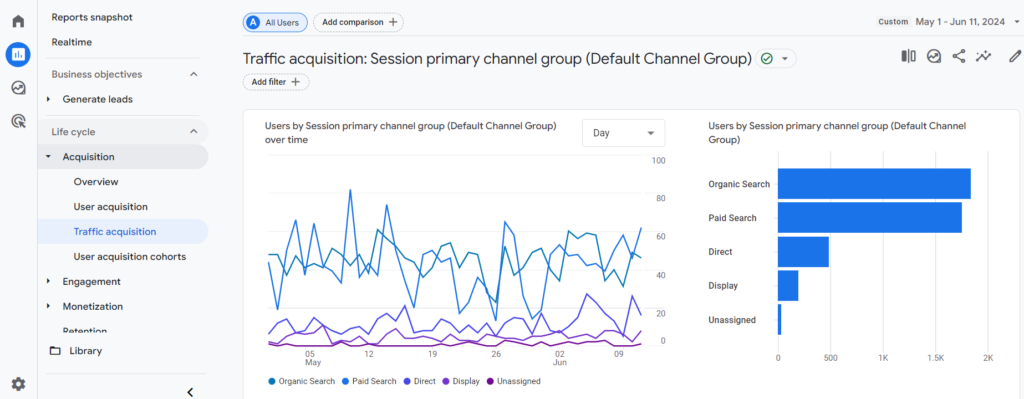
    Google Analytics provides data about the activity that occurs on your website. This includes your web traffic, where users are coming from (e.g. organic search, paid search, email campaigns, etc.), and their behavior on-site.

    You’re also able to track custom conversions or key events, like when a user schedules an appointment or signs up for a rewards program.

    Get started with your Analytics set up here.

    Step 2: Link your site with Google Search Console. 

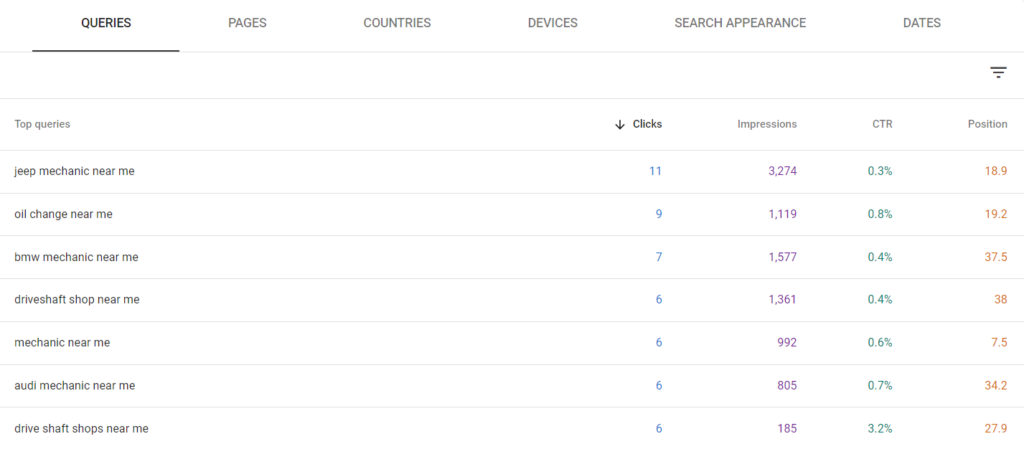
    Google Search Console tracks how your website is ranking on Google. It provides data on the search queries you’re ranking for and can be broken down by page, country, device type and more.

    Get started with your Search Console set up here

    Step 3: Link Your Site with Google Tag Manager

    Finally, Google Tag Manager is great for setting up custom events such as form submissions, clicks to particular links, and more.

    This tool is a bit more advanced and will require some time to get the hang of.

    There are a ton of great resources out there for learning the ins and outs of Google’s tools and how they all work together. Analytics Mania is one of them, and he has a Tag Manager tutorial for beginners

    Get started with your Tag Manager set up here.

    Google Business Profile

    Step 4: Complete Your Business Profile

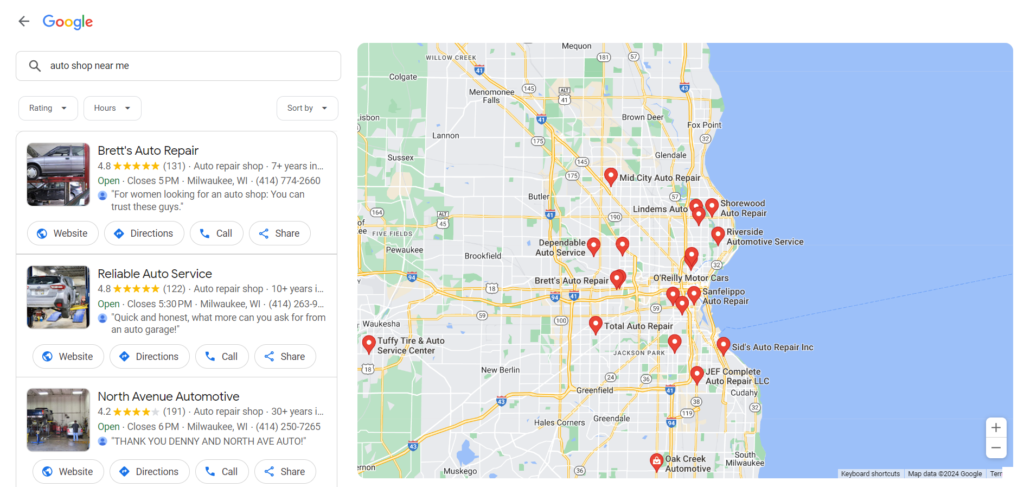
    Google Business Profile is the cornerstone of any local SEO strategy. For our primary auto shop client, about 30%–40% of their organic traffic comes from their Google Business Profile. 

    If you do nothing else for search marketing, complete your Google Business Profile!

    And check out our complete guide to setting up Google Business Profile!

    Step 5: Remain Active of GBP

    But your Google Business Profile isn’t a “set it and forget it” kind of tool. Once your profile is set up, it’s important to remain active. 

    Activity such as updating holiday hours, uploading photos, creating posts for deals and promotions, and responding to user reviews has been shown to impact your GBP rankings.

    Positive user reviews are also a huge influence on click-through rates and, ultimately whether or not a user decides to schedule an appointment. Be sure to follow up with customers in an email and ask them to share their experience. Don’t forget to include a link to make it as easy as possible.

    Know Your Keywords

    Step 6: Write a List of Your Target Keywords

    Generally, auto shops are going to target the same cluster of keywords. This may change between shops depending on the services you offer or areas you specialize in.

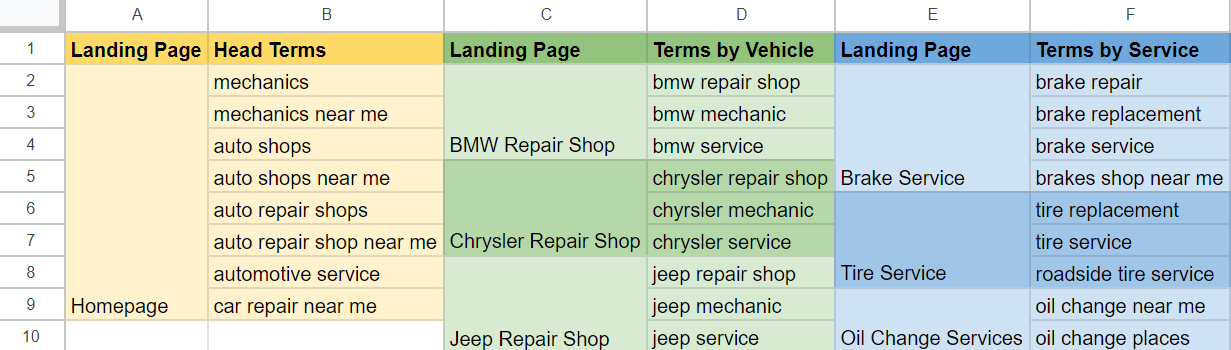
    But generally speaking, we can break down our keywords into three categories based on how users search for mechanic services.

    Head termsTerms by vehicleTerms by service
    mechanics 
    mechanics near me
    auto shops
    auto shops near me
    bmw repair shop
    honda mechanic near me
    chrysler service near me
    jeep repair specialist
    brake service
    oil change near me
    wheel alignment near me
    driveshaft repair 

    Step 7: Map Your Keywords

    For SEO, we typically map a keyword (or keyword topic) to one landing page.

    For instance, your homepage will usually be mapped to the most frequently searched and broadly applicable terms (head terms). So the content of your homepage will be optimized to target terms like mechanics and auto shop. We’ll discuss this more in the next step.

    The secondary terms (the terms by vehicle and service) will need separate landing pages in order to target effectively. We typically recommend that our auto shop clients build a landing page for each service they offer and for the most popular brands of vehicles they service.

    Website Optimization 

    Step 8: Optimized Your Homepage

    Your homepage is critical for both users and search engines.  It sets the tone for your website and helps users understand what you do and how you can help them.

    Your primary terms will likely include “auto repair,” “auto shops,” or “mechanics near me.”  These are the keywords your homepage will target.

    It’s also beneficial to add localization to your keywords. If your shop is in Jacksonville, then we’d include “Jacksonville Auto Repair” as a keyword.

    Title Tags

    The title tag is the main title of your webpage that appears in search engine results. Make sure it includes your target keywords and is under 60 characters.

    For example: Auto Repair Shop in Jacksonville | Jax Automotive Service

    Header Tags

    Use effective headers that incorporate relevant keywords.  For instance, your H1 (the main header) should be something like “The Premier Jacksonville Auto Repair Shop.”

    Your other header tags (H2s, H3s…) don’t necessarily need keywords. However, they should be relevant to the page topic.

    If you were to look at the header tags in isolation, you should be able to tell they were taken from an auto shop website (i.e. “We’ll Get You Back On The Road In No Time!”)

    Body Content

    Write informative paragraphs that communicate what your business is and who you serve. Including strong sentences like: “Jax Automotive Service is a proud Jacksonville mechanic serving drivers from across the county!”

    Best practices recommend page content to be at least 300 words. This gives search engines enough “meat” to decipher what the page is about and who it’s best for.

    Call to Action

    Make sure you have a clear call to action.

    Prefer your customers call to schedule an appointment? A prominent phone number on your page or header is key.

    Have an online appointment scheduler instead? Make sure the form is clearly present on the page or obvious buttons that link to the form page.

    Step 9: Create (or Optimize) Your Secondary Landing Pages

    Secondary landing pages target search queries with lower volume like your vehicle or service terms.

    While search queries like “auto shop” or “mechanic near me” are going to be your primary focus, it’s still important to have content that will pick up those less frequently searched terms like “mercedes mechanics”

    The same principles apply to these pages just as they did for your homepage. Think about title tags, header tags, body content and call to actions.

    Step 10: Blog articles

    Regularly publishing blog articles is a great way to supplement your SEO efforts. Writing about common car problems, seasonal maintenance tips, or even featuring customer testimonials can signal to search engines that you are an expert authority that users can trust.

    Blog content also keeps users engaged, leading to longer visits and higher interaction rates—signals that search engines use to gauge a site’s quality and relevance.

    Plus, well-written articles can generate backlinks. Other website may link to your article which increases your site’s authority and improves its ranking on search engine results pages.

    The Potential Numbers

    As mentioned, we’ve implemented this strategy in the past with great success. 

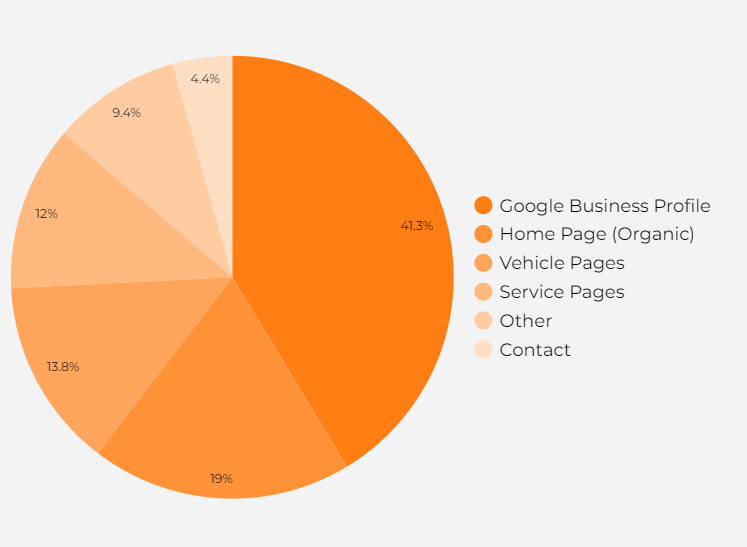
    To give you an idea of one potential outcome, here’s a breakdown of where traffic comes from after a few years of implementation and refining. 

    Most of our business traffic (meaning non-blog traffic since blog traffic typically doesn’t convert into customers) comes through the Google Business Profile, which is why it’s such an important piece of the SEO puzzle. 

    Google Business Profile traffic is followed by organic traffic to the homepage; this is traffic that clicks through to our site via the blue links instead of the GBP.

    Following the homepage, our Service and Vehicle pages collectively make up about a quarter of our business traffic. While it’s a smaller piece of the pie, it’s definitely not something to ignore.

    Wrapping Up

    Optimizing your auto shop’s online presence involves a multifaceted approach that includes understanding your target keywords, effectively mapping these keywords to specific landing pages, and ensuring that your homepage and secondary pages are optimized for search engines.

    By focusing on strong SEO practices, regularly updating your blog with relevant content, and engaging with customers on social media, you can significantly enhance your visibility and attract more potential customers.

    Remember, consistency and continuous improvement are key to maintaining a strong online presence and achieving long-term success.

    If you’re interested in learning more about how we can help improve your search visibility, check out our auto shop SEO services!

  • Does Duplicate Content Hurt SEO?

    Does Duplicate Content Hurt SEO?

    Can Publishing Duplicate Content Hurt Your Search Engine Rankings? 

    Duplicate content is a persistent concern for website owners and SEO specialists alike. From near-identical pages to sections of content reused across a site, the ramifications of duplicate content on search engine rankings are often debated. 

    In this article, we delve into the nuances of duplicate content and its impact on SEO. We explore different scenarios, from full-page duplicates to spun content, to understand when and how duplicate content can affect your site’s performance in search engine results pages (SERPs).

    TL;DR

    • There are different ‘degrees’ of duplicate content (from spun copy to identical full-page content)
    • Generally, duplicate content won’t severely impact your rankings. Google will usually pick the most appropriate page to rank
    • But full-page duplicates carry the potential to hurt your rankings, especially if there are other conflicting signals.
    • Duplicate sections (as opposed to full pages) also shouldn’t impact rankings; so long as the primary focus of the page is not duplicated content
    • Spinning content can be a useful tool, depending on the intent of users. Informational content isn’t good for spinning but commercial/transactional content is usually okay

    There is a Range of Duplicate Content

    Duplicate content can refer to a range of cases. Sometimes we’re talking about duplicates of pages, differentiated only by their URLs.

    It can also refer to sections of content that appear on multiple pages across your site. 

    And other times, duplicate content can refer to text that has been lightly edited–or spun–in order to appear original.

    We’ll take a look at all three cases and what impact (if any) it can have on your ability to rank on the SERPs.

    Full Page Duplicates

    Full-page duplicates are when the same page is effectively copied and pasted.

    Search engines especially dislike this type of duplicate content because it makes it more difficult to determine which pages to prioritize in the rankings. 

    Although most of the time, Google doesn’t have too much trouble and can select one version of the pages to show.

    However, as we found out the hard way, this isn’t always the case. There are some instances in which duplicate content can hurt SEO performance. The case study below demonstrates one of those instances.

    Case Study of Full-Page Duplicate Content

    We have an e-commerce client that has thousands of product pages. Last year, they had a technical hiccup in which some of their pages were republished under a new URL. 

    So for a while, we had two identical versions of many product pages.

    While their developers quickly solved the main issue, there were still a few duplicate pages out there that we didn’t catch right away. 

    But once we did, it gave us an interesting peek into what can happen when you have identical content on your site. And the results are kind of frightening.

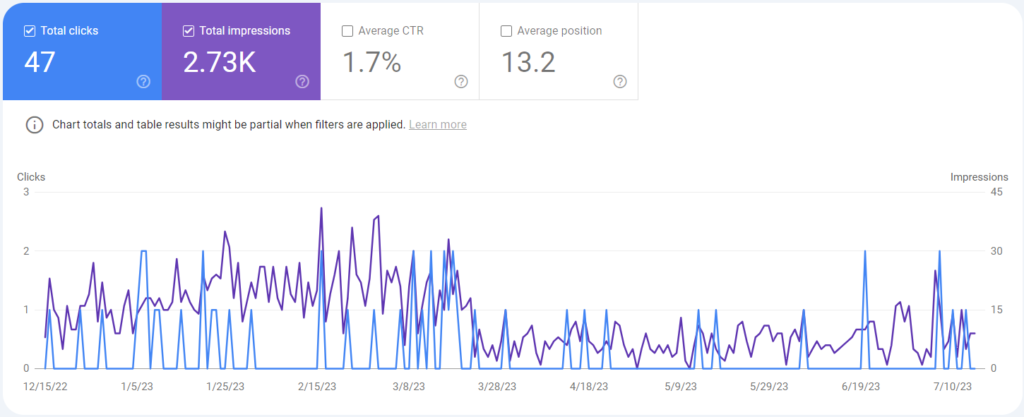
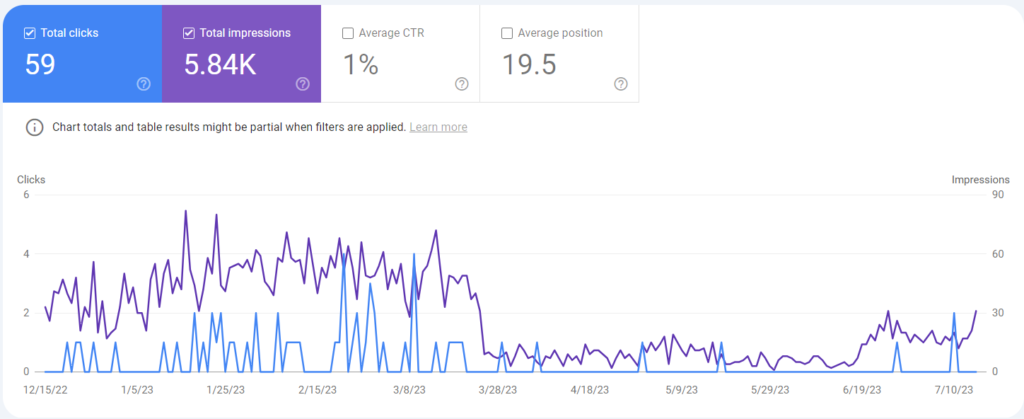
    Here are some screenshots of Search Console performance when filtered to include both versions of the duplicated page.

    When the issue occurred in late March, performance tanked for pages with duplicate versions. Neither the existing page nor the new version ranked well.

    This is what we believe happened:

    The original pages had a longer history with a more robust backlink profile, which gave it a fair amount of “ranking power.”

    However, the links from the client’s internal catalog were overwritten and instead linked to the new versions instead of the original, which sent mixed signals to search engines regarding which version to prioritize.

    And this bumped us down quite a bit in the rankings.

    This was an easy fix once we caught it and performance for those pages soon recovered. But it demonstrates vulnerabilities when publishing identical content (whether intentionally or not).

    Duplicate Sections

    By duplicate sections, I mean identical content that doesn’t make up the primary focus of the page. Generally speaking, duplicate sections won’t have a negative impact on rankings. 

    As long as the remainder of the page’s content hits the criteria required for ranking, then duplicate sections aren’t going to slow things down.

    For example, one of our clients has a section that serves as a call to action with a fair bit of text that they post on their blogs, FAQs and other information-serving pages.

    Since these are primarily informational pages, the call to action isn’t going to play a big role in Google’s analysis of the page.

    But if these sections take up a more substantial portion of the page, it might be worth rewriting the content in order to ensure its originality.

    It’s useful to think about it like this: If you were to remove the section in question, would the page still make sense? Would it still accomplish its goal? If we remove the CTA of the pages mentioned above, then yes, the page would absolutely still make sense and accomplish its goal of informing our audience.

    But there are some instances where rearranging, rewriting, or spinning the content would make sense (more on that below).

    Similar (or spun) Content

    Sometimes, it’s necessary to rewrite existing content–called spinning. 

    But this raises similar questions. Does Google view spun content as ‘legitimate’? Can “spun” content hurt my SEO performance?

    Spinning Content is the practice of rewording existing text to communicate the same ideas but avoiding the appearance of duplicate content or–for some black-hat actors–plagiarism.

    As usual, the answer is–annoyingly–it depends.

    While Google won’t manually penalize sites unless there is obvious malicious behavior, I wouldn’t go so far as to say that publishing spun content can hurt SEO.

    It’s more accurate to say that spinning content is often just a waste of time. Not always. But often.

    When Spinning Content is a Waste of Time

    I’d argue that spinning content is a waste of time when you’re trying to rank for queries with informational intent.

    Google prioritizes content that:

    • contains original information, reporting, research, or analysis
    • provide a substantial, complete, or comprehensive description of the topic
    • offers insight or information beyond the obvious
    • and avoids simply copying or rewriting those sources

    While it’s not perfect, Google is generally pretty good at ranking content that offers more than generic or regurgitated answers to common questions.

    And in our experience, spun content–and even content that’s relatively original but offers little more insight than the sources we used to write it–almost never generates traffic for informational queries.

    However, we have had success when spinning content for queries with commercial or transactional intent. Here’s a case study to demonstrate.

    Case Study of Spun Content

    We have a client that serves Los Angeles with moving services.

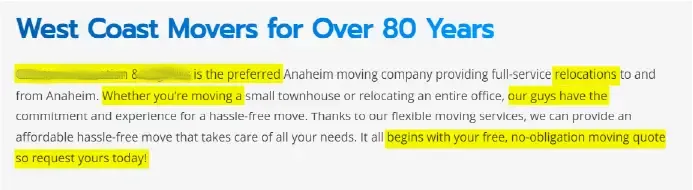
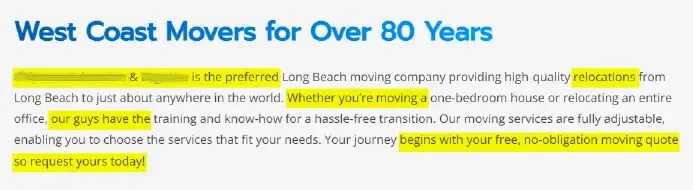
    L.A. has a huge geography with many towns and smaller cities within it. So, as part of our SEO strategy, we published Areas Served pages that target localized search queries (e.g., anaheim movers and movers in beverly hills, etc.).

    With hundreds of these pages to publish, it’s incredibly difficult and time-consuming to write completely original content for each one. So oftentimes, we’ll spin the content.

    While this content is relatively unique on the surface, it’s functionally identical. Google’s crawlers won’t process a distinction between synonyms such as hassle-free transition and hassle-free move.

    So if the content isn’t unique (i.e. duplicate content) why doesn’t this hurt SEO performance? 

    I’d argue it’s because the commercial intent to purchase moving services in a specific geography–Beverly Hills–means the pages’ different geographic focus is enough to make them sufficiently unique.

    A user in Anaheim doesn’t want a page on services in Beverly Hills and vice versa.

    Given the relative success of these particular pages and our Area Served page strategy, it’s safe to assume that Google considers this kind of spun content to be acceptable. 

    Wrapping Up

    Navigating the intricacies of duplicate content in SEO requires a nuanced understanding of search engine algorithms and user intent. While some instances of duplication may have negligible effects or even prove beneficial, others can significantly impact your site’s visibility and ranking potential.

    By recognizing the various forms of duplicate content and implementing strategies to address them effectively, website owners can optimize their SEO efforts and enhance their online presence in a competitive digital landscape.

  • The Role of SEO in B2B Marketing

    The Role of SEO in B2B Marketing

    On the surface, SEO’s role for B2B is simple: help generate sales. However, where SEO comes into play for sales impacts the SEO strategy

    Business-to-business is often discussed as if there is a monolithic go-to-market strategy that somehow applies to all B2B companies. Obviously, this isn’t the case. So, when we talk about SEO, we have to go beyond B2B and beyond the specific industry to understand the individual company’s sales process.

    The Target Metrics For A Website

    Websites are marketing tools. Like any other marketing tool, successfully developing and managing a site depends on defining its purpose/goal. 

    In general, we find that the website, and therefore SEO, plays a role in one or more of three areas.

    Direct Online Sales

    The easiest and most direct metric for a successful website is e-commerce revenue. When selling services, equipment, parts, or consumables online, we have a direct attribution to organic search. 

    Lead Generation

    Lead generation is more commonly a target metric for B2B. While measuring leads and attributing them back to the sources is relatively straightforward, tying back the quality of these leads is less so. This becomes more challenging as the sales cycle becomes more complex.

    Sales Support

    This is more amorphous. For complex or longer-cycle sales processes, websites often become the go-to channel for prospects. Making sure content is easily accessible and discoverable or appears in Google search results when prospects continue with research can make or break a sale. While there is no hard metric for Sales Support, UX and SEO visibility play a key role.

    The Purchase Process

    What is the process from shopper to prospect to customer? For some industries, there may be a standard that applies to most companies, but that is not always the case. Two companies in the same industry may have different growth strategies. One may have an active Outbound Sales Team, while another may have a Product Lead Growth strategy. These involve two distinct buyer experiences even within one vertical.

    Short-Cycle

    From the time a customer identifies a need to the time the purchase is made, it can be a day or perhaps a few days. We often see this in parts and consumables. There is not a lot of research taking place. So, you have to make it to the shortlist quickly, identify and communicate the KSP immediately, and have a 1-3 day communication plan. 

    There is very likely an e-commerce component or a rapid response lead generation program. Once the transaction is complete, the buyer will unlikely visit the site again until another need arises. 

    Mid to Long-term Sales Cycles

    Longer sales cycles tend to involve higher costs or longer-term commitments. They also involve more touch points, research, and a greater need for rich content. The website must support the communication coming to the customer during the sales process as well as support the prospect in providing information during their research. 

    At this point, there is another discussion on customer relationship management involved, which is beyond our scope here. 

    Key Content For Websites in B2B Sales

    Knowing the target audience is vital to prioritizing and developing the website’s content. While all three of the following areas are important, their weight and focus on a site depend on the purchase process and sales strategy. 

    Product/service education

    This can span the category or the company’s specific offerings. The website has to provide sufficient information to educate prospective customers and demonstrate a level of expertise to make prospects comfortable.  

    Company Authority

    Higher costs and longer commitments come with more risk and require more support. But even with lower cost/commitment services, sellers must convey their authority and expertise in the marketplace to make it to a buyer’s shortlist. It is not enough to just describe products or services. The website must convey experience in the industry.

    Company Trustworthiness

    From transaction/information security to post-sale fulfillment, a website has to communicate trust. Verifiable customer reviews, a commitment to providing references, and real case studies are critical to establishing the trust needed to make it onto a prospect shortlist. It is not sufficient to simply list what a company sells; websites have to convey trust. 

    What about SEO for B2B Websites?

    We didn’t forget. But SEO comes after all the above. While we work on SEO strategy, SEO is a tactic within the sales and marketing areas. So, first, all the above-mentioned needs to be figured out, and then search engines and how to structure content for them can be considered.

    One challenge for digital agencies is when clients or prospects begin with SEO discussions (or digital marketing in general) prior to the marketing and sales strategy.  We can work to get content to rank with search engine optimization, but if it is not the right content or not targeted to the right part of the sales funnel, then even page one ranking is not going to move the needle… well, maybe a little. But the point is that we must have the right goals in place for SEO to be effective.

    Fortunately, we have been around long enough to help our clients lay the groundwork for a good digital marketing program, including SEO.

  • Do No-Follow Links Help SEO?

    Do No-Follow Links Help SEO?

    First, What’s a No Follow Link?

    A no-follow link is a hyperlink that looks like this:

    <a href = “https://fanaticallydigital.com/” rel= ”nofollow” >

    See the no-follow tag? This tag tells search engines to ignore the link.

    A Brief Refresher on Search Engine Crawlers

    Search engines use hyperlinks like these to create a map of the web.

    They’ll read the content of web pages and use hyperlinks to jump from page to page and website to website.

    The more links that a page has pointing to it, the more valuable the page is assumed to be and, therefore, the more potential that page has to rank.

    No-follow tags tell search engines not to include the link in their web map.

    Why Do Websites Use No-Follow Links?

    You’ll most often find no-follow links in social media posts, comment sections, and forums.

    Back in the early days of Google, savvy folks realized you could spam blogs and forums by linking to their own websites in the comments. 

    This would artificially inflate the number of links pointing to their own website, making it seem more valuable.

    To combat this, Google introduced the no-follow tag in 2005, and other search engines quickly followed suit.

    Nowadays, search engines have become smarter and can detect spammy behavior regardless of no-follow tags.

    But you’ll still find them across the web, like on social media, certain blog posts and news sites like Forbes and Huffington Post.

    No Follow Links & SEO

    There’s a fair amount of debate in the SEO world over the value of no-follow links.

    And Google doesn’t help clarify the issue, saying “In general, we don’t follow them.”

    When it comes down to it, a no-follow tag is merely a suggestion that search engines ignore the link.

    Do No-Follow Links Help SEO?

    In short, yes. No-follow links have the potential to help your SEO.

    Let’s take a look at a few case studies that correlate no-follow links with improvements in organic rankings and traffic.

    Case Study 1

    An agency called Teknicks ran a case study in which they increased a client backlink portfolio over 16 months, 89% of which were no-follow links.

    The client saw a 288% increase in organic traffic.

    Now, this is not a perfect study (SEO studies never are). It doesn’t control for other factors, such as the impact of on-page content changes or the 11% of new links that were do-follow.

    However, the gradual increase in keyword rankings and traffic suggests that no-follow links could absolutely have contributed to their success.

    Case Study 2

    Another case study conducted by SEOJet does a better job of demonstrating a more direct relationship between no-follow links and improved rankings.

    After being stuck on the third page for “backlink software,” SEOJet placed a no-follow sidebar link on an SEO blog.

    Although it was only a single backlink, the results were immediate. They jumped to the first page within a week.

    Why would this be?

    Google May Still Follow Them

    Again, a no-follow link is merely a request that search engines ignore the link.

    This second case study suggests that Google does follow certain backlinks, especially if the content is relevant.

    Referrals Matter Too!

    When discussing backlinks and SEO, we often forget about the value of referrals.

    Links placed in relevant locations can bring in referral traffic, people who navigate to your site from the hyperlink.

    These are real human beings who check out your website and could potentially share it with others. This is a valuable benefit that shouldn’t be overlooked.

    So, Do No Follow Links Help SEO?

    In summary, no-follow links do have the potential to help your SEO by increasing organic traffic and referral traffic.

    However, the impact of no-follow links is often indirect and can be difficult to measure. 

    In addition, Google’s algorithms are constantly changing and evolving, making it challenging to determine the exact impact of no-follow links on SEO.

    Ultimately, while no-follow links may not necessarily directly contribute to your website’s rankings on search engine results pages, they can still play a role in driving traffic to your website and increasing its overall visibility.

    So, the next time you come across a no-follow link, don’t dismiss its potential value.

  • Technical SEO An Overview

    Technical SEO An Overview

    Technical SEO is the process of ensuring search engines can access and easily crawl your website. From very basic things like a proper server response to the many aspects of how content is delivered to the web browser, they are reviewed and adjusted as part of technical SEO optimization. When done properly, search engine bots can crawl the site, and the search engine can index it so that it appears in the SERPS.

    Website Speed

    Website speed can be tricky in that site owners may not fully understand the elements involved. From their perspective, when they go to their site, it seems to load fast, and they’re lulled into believing that they have good site speed. But this is not necessarily the case.

    Browser Cache & Load Speed

    Browser caching is fairly standard practice. This means that the content one sees after visiting the site for the first time is rendered from the browser’s memory or cache, a very fast experience. This was developed to improve the user experience and to decrease the load on servers and bandwidth. For a site with frequent repeat visitors and few content changes, this is great. But, new visitors to a page may have a very different experience, and perhaps not a good one.

    Because site owners frequent their own sites often, their experience comes from the cache more often than from the server. When Google assesses a website’s speed, it does so from the perspective of a first-time visitor with no browser cache. Google’s assessment and a site owner’s speed experience can be very different.

    Content and Speed

    When site owners think of content, they typically think of what they see. But, when Google assesses site speed, there is a great deal more involved. Using PageSpeed Insights, SEOs can see the various elements of a page that are causing issues with load times. Here are three common speed bumps for websites.

    • One of the most common issues with non-optimized sites usually involves images that are way too large and not web-optimized.
    • Unused CSS and JS code is also an inhibitor to page loading
    • Render-block scripts cause issues with visible content not being loaded because it has to wait for js or other scripts to load first.

    Improving site load speed is one of the more difficult things to do. Balancing image size with creativity/quality and knowing what parts of the scripts are vital to the initial load versus what can wait or be eliminated, it is time-consuming to optimize for speed.

    Page Architecture

    Behind the content people see is code. Website architecture, including the code structure, helps search engines parse and understand the content. One of the tricky things is that you can use different approaches to render content the way you want users to see it, but those methods may not be good for search engines to understand it. The content needs to be rendered well for users and structured well for search engines. Both are absolutely compatible, but often one is forgotten.

    General User Exprience

    Beyond load speed, Google also looks at what happens when content is rendered. Is it within the screen, does it shift once loaded, is the contrast between elements visible, how is the element spacing, and so on? These elements play into how users will see and navigate the site.

    Trickier still, how the site is rendered is different for desktop vs mobile. Generally speaking, if the site is mobile-friendly, it will be good for the desktop. But, the reverse is seldom true. Whether using a mobile-first approach or depending heavily on responsive design (which should be ever-present anyway), the site code has to adjust the rendering appropriately for the users’ devices.

    These more common elements of technical SEO need to be addressed for every website to some degree. How deep you have to go and how much effort is needed really depends on your starting point.

    While there are tools out there that can identify problems, their proposed solutions are not always easily achieved by the average site owner. The process needs to set priorities and provide the right resources, which are often not available. If you are wondering how to improve site speed for your website, give us a call.

  • The Impact of AI on SEO (So Far)

    The Impact of AI on SEO (So Far)

    Generative AI & SEO

    In the rapidly evolving digital landscape, Artificial Intelligence (AI) has emerged as a game-changer, particularly in the realm of Search Engine Optimization (SEO).

    As we reflect on the pivotal year of 2023, it is evident how large-language-models (LLMs) and generative AI tools have revolutionized SEO practices, akin to the transformative impact of internet and smartphones.

    In this post, we’ll delve into the impacts and implications of AI on SEO, highlighting the efficiency and value brought by AI tools in simplifying labor-intensive SEO tasks, while also examining the yet-to-be-realized potential of AI-generated search results in influencing website traffic.

    AI & SEO Tools

    When it comes to search engine optimization, the biggest impact AI had was in the available toolset. Copywriting programs, bulk on-page optimization, and rank tracking tools have streamlined the more tedious aspects of SEO.

    Content Generation

    After the release of ChatGPT’s API, content generation software quickly became ubiquitous throughout the SEO and content marketing space.

    Tools like Jasper and Copy.ai  can assist SEOs by suggesting blog topics, assist in writing the blogs posts themselves, as well as generate website copy like product descriptions.

    As you can imagine, these tools helped to cut down the time and effort for tasks that many SEOs may find tedious like researching new potential blog topics and content spinning.

    Data Analysis and Trend Identification

    AI tools have also revolutionized data analysis and trend identification in SEO. Tools such as Pro Rank Tracker and MarketMuse can automatically perform keyword research, identify content gaps on a website, and suggest topics for future posts.

    These AI-assisted programs allow for a new level of precision to keyword research and trend identification, enabling quicker response to search trends.

    SEOs also find value in the predictive insights that these tools provide, allowing content to be appropriately tailored for future search algorithm changes.

    When used properly, these advancements in natural language processing (NLP) and AI free up SEO from the more tedious elements of their job to focus on the strategic side for their clients.

    Impact on Search Engines

    Natural Language Processing & Search Engine Algorithms

    In the early days, search engines relied heavily on keywords to understand a given text and match search queries to the appropriate results.

    However, with the advancements in natural language processing (NLP) and AI, search engines can now analyze content more comprehensively and better understand context and intent, allowing for more accurate results.

    This has rendered old SEO tactics such as keywords stuffing obsolete. Over the years, content marketers have had to place a greater emphasis on the quality and relevance of their content.

    One example of these NLP algorithms in action is Google’s BERT, which uses AI to understand the meaning behind a search query and deliver more relevant results.

    With systems like BERT, search engines are able to understand more complex and conversional queries and factors in context from previous searches.

    This has led to the rise of voice search and the need for SEOs to optimize their content for natural language queries.

    In essence, AI has forced SEO professionals to shift their focus from optimizing for robots to creating valuable and user-friendly content.

    Generative Search Results

    While advancements in NLP has had a massive impact on how search engines’ process language over the past decade, much of these improvements have occurred behind the scenes. However, technologies unveiled in the past year and a half have the potential to advance the capability of search algorithms to a new stage in their evolution.

    We’ve seen these NLP and AI advancements go from improving search engine’s ability to understand and interpret text to actually generating text themselves. No longer simply selecting the best results for a particular query but understanding intent well enough to formulate a response itself.

    Programs such as Google’s Search Generative Experience and Bing’s Copilot use generative AI to create answers to search queries on the spot by cross referencing relevant organic results with their own internal knowledge graph.

    This technology has vast implications for SEO, as websites will need to compete not only for top placement in search results but also for generating the most relevant and accurate information.

    As of now, these AI-generated search results have yet to achieve widespread prevalence that significantly impacts website traffic. However, as this technology continues to advance,  it may dramatically alter the current SEO landscape.

    Wrapping Up

    In conclusion, AI has already had a significant impact on the world of SEO, primarily through automation and optimization of tasks. But as we’ve seen with NLP advancements and generative search results, the potential for AI to shape the future of SEO is immense.

    While it’s unclear exactly how these technologies will continue to evolve, it’s safe to say that AI will be a driving force in the world of SEO for years to come. As search algorithms continue to improve and become more sophisticated, so too must our strategies as SEO professionals.